
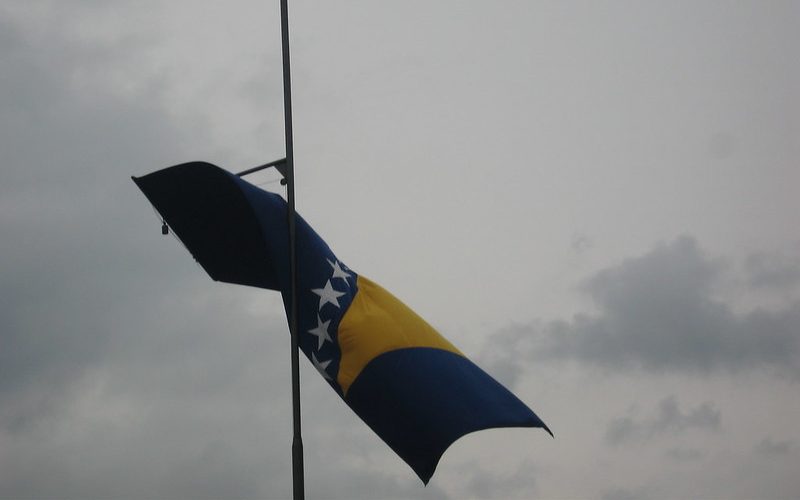
In 2019, the President of Serbia Aleksandar Vucic announced that he, along with Prime Minister of Albania Edi Rama and the Prime Minister of North Macedonia Zoran Zaev, signed a declaration of intent to establish the free movement of people, goods and capital between these three countries in the Western Balkans – a Mini-Schengen, they called it. The response of Bosnia and Herzegovina to the initiative was flawed, to say the least.
The political system of Bosnia and Herzegovina is extremely complex and expensive. Most of the decisions that needed to be adopted on the path to EU accession are being ignored because of political reasons. Even if certain steps are being taken in the right direction, it is because the international community involved itself in the process. One example of this sad reality happened a few days ago when the Council of Ministers BiH adopted a revised National War Crimes Strategy (one of the fourteen key points from the European Commission’s opinion on Bosnia’s EU membership application which has been adopted on 29th of May, 2019) only after they held an online meeting with EU Ambassador Johann Sattler.
We do not know what the ambassador told the Council. But judging from the sarcastic comments by the Minister of Justice Josip Grubesa at the press conference that “Bosnia is a land of wonders where anything can happen”, there was likely a significant diplomatic pressure from the European Union. The National War Crimes Strategy was blocked from being adopted numerous times during 2020 and outside political actors needed to take action in order for the Council to adopt it.
Why is this important to mention? Because a few days ago, the tripartite Presidency members Sefik Dzaferovic, Zeljko Komsic and Milorad Dodik travelled to Brussels to meet with EU dignitaries in order to discuss the European future of Bosnia and Herzegovina and about the future of the Mini-Schengen.
When Mini-Schengen was first announced, the Presidency of Bosnia and Herzegovina disregarded it completely. They did not see the point of Bosnia entering that sort of an agreement, because CEFTA (Central European Free Trade Association) has been in place since 2006 and it offers almost the same benefits as Mini-Schengen would have offered: Freedom of movement of goods and services. Also, most people from the Republic of Srpska, an enclave of BiH, already cross the border with Serbia using only ID cards.
This was, in my opinion, the first mistake of the Bosnian Presidency. Instead of disregarding the idea completely, they should have mobilized all of our diplomatic corps in Albania, Serbia, North Macedonia, Montenegro in order to find out more about this initiative and what elements exactly it would entail. After a thorough analysis by economic experts, our diplomatic corps should have been mobilized in the EU and US in order to, either stop this initiative in its beginnings, or to support it fully if Bosnian interests will not be at stake.
Instead, the Presidency waited a year before ordering the relevant institutions to conduct a thorough analysis of the Mini-Schengen initiative, after the United States officially backed the Mini-Schengen plan in the Serbia-Kosovo agreement, which was signed a few weeks ago in Washington D.C.
The Bosnian negotiating position in the subject matter has been weakened significantly by the disinterest and inactivity of the Presidency of Bosnia and Herzegovina. If BiH decline to enter the Mini-Schengen initiative, it would be left alone and isolated between the large Schengen (EU) on the West, and the Mini-Schengen in the East.
If BiH accepts, on the other hand, it will be overshadowed by Belgrade, because Serbia has the largest economy in the region and because BiH was not part of the negotiating processes from the very beginning. Bosnia and Herzegovina made the same mistake with CEFTA in 2006 because it did not negotiate its position properly so we ended up importing a lot more products from the region than exporting domestic products. Nobody has yet seen the official Mini-Schengen document and what exactly it would entail remains to be seen.
Presidency members came back from the meetings in Brussels with positive attitudes stating that, next week the EU will present a package of economic support for Western Balkans. Also, enlargement is still on the table if Bosnia and Herzegovina continues to work hard in fulfilling the necessary reforms. The EU will also assist BiH in dealing with the migration crisis, even though they should have done that long ago since Bosnia is carrying the heaviest load out of all the states in the region when it comes to migration.
Regarding enlargement, the Presidency announced that Bosnia and Herzegovina should attain candidate status early next year which I do not believe will happen because of the above-mentioned reasons of BiH institutional problems. It takes way too long to solve problems, even with the support of the international community.
It is interesting though, how European Union officials invited members of the Presidency a month before the local elections. Now the nationalistic parties in power can use this trip and the promise of candidate status during the campaign as positive steps they have made and call for their reelection. However, in reality, they are the ones that blocked the progress of the country due to their petty political disagreements.
To summarize, Bosnia is stuck between a rock and a hard place. If it accepts to become a part of Mini-Schengen, Belgrade reaps most of the benefits. If it refuses, it gets stuck in limbo, completely ignored by the region and Europe. Regional cooperation, whether it is economical or even security cooperation, in my opinion, is a positive step towards reconciliation and increase of trust between neighbours but only if it is negotiated properly in order to ensure national interests will not be damaged. One of the positive examples of regional cooperation is the Visegrad Group: Four countries cooperating with one another to assist each other in the EU integration process. Sadly, politicians in Bosnia and Herzegovina are too incompetent and unwilling to protect their country’s interests and allow others to dictate its future. A fact for which sadly, ordinary citizens will pay the price.
Sources
European Commission (2019): Commission Opinion on Bosnia and Herzegovina’s application for membership of the European Union https://ec.europa.eu/neighbourhood-enlargement/sites/near/files/20190529-bosnia-and-herzegovina-opinion.pdf, accessed 03.10.2020
EEAS (2020): Bosnia and Herzegovina: HR/VP Josep Borrell met with the tripartite Presidency, https://eeas.europa.eu/headquarters/headquarters-homepage/86143/bosnia-and-herzegovina-hrvp-josep-borrell-met-tripartite-presidency_en, accessed 03.10.2020.
Klix (2020): Borrell “ohrabrio” Predsjedništvo BiH da provode sve reforme na putu ka članstvu u EU, https://www.klix.ba/vijesti/bih/borrell-ohrabrio-predsjednistvo-bih-da-provode-sve-reforme-na-putu-ka-clanstvu-u-eu/200930133, accessed 03.10.2020.
Ministry of Foreign Trade and Economic Relations of Bosnia and Herzegovian (2020), http://www.mvteo.gov.ba/Content/Read/regionalni-trgovinski-odnosi-cefta?lang=bs, accessed 03.10.2020.
Be First to Comment