
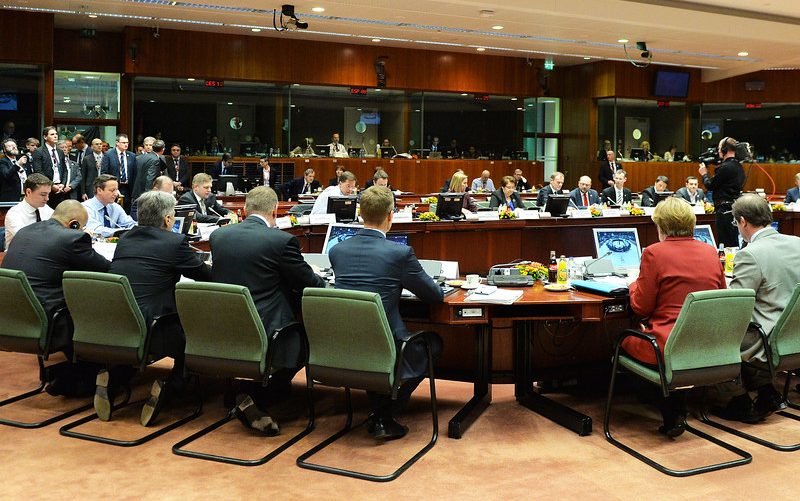
In the past weeks, it became once again clear that the EU’s unanimity requirement in the Council to make decisions in its foreign and security policy presents severe obstacles to its work and credibility worldwide.
One recent example is the EU’s flat out inability to decide on sanctions in Belarus after fraudulent elections and the crackdown on protestors in August 2020 – due to a deadlock by Cyprus. Only recently, almost two months after the Belarus elections, the EU finally imposed sanctions.
But likewise, other issues that the Council of the European Union unanimously votes on time and again laid bare the EU’s weakness in its decision-making in the past years. For example, unanimity hampered European leadership during the crisis in Venezuela and in questions on human rights abuses in China.
However, calls on the EU to finally discard the unanimity rule are not new. It has been a longstanding request from people in- and outside of the EU to move from unanimity to qualified majority voting. Prominent examples of this are former Commission president Jaune-Claude Juncker, who asked to eliminate it on issues related to taxation and foreign affairs, as well as Guy Verhofstadt, member of the European Parliament, who time and again voiced concerns that unanimity is killing the EU’s credibility. Similarly, current Commission president, Von der Leyen, called on the member states in her 2020 State of the European Union speech to be “courageous and finally move to qualified majority voting – at least on human rights and sanctions implementation.”
Generally, moving from unanimity to qualified majority decision-making would ensure that the Union can act fast on internationally pressing issues. It would increase the EU’s effectiveness as a global actor since it guarantees that member states can no longer block certain decisions. It would also make sure that the EU saves face via-á-vis other global actors and emerging actors.
Yet, changes to the unanimity requirement in certain policy areas are unlikely, because this would require a change in the treaties – and treaty changes would, in turn, require unanimity again. And this is hardly achievable in the EU as divided as it currently is. Moreover, few countries would want to give up the unanimity rule, as it gives them the leverage to successfully veto and reject any policies that come their way and are unfavourable to them. In addition, some countries like to use their veto on certain foreign policy issues to draw attention to another problem or something of their national interest and thereby exert pressure – as recently done by Cyprus when the EU tried to decide on the Belarus sanctions. Cyprus also wanted sanctions against Turkey in response to the standoff between Turkey and Cyprus over maritime borders and energy resources in the eastern Mediterranean. Lastly, abolishing unanimity is unlikely since it is also required when deciding on sanctioning another EU member state in the course of an Article 7 procedure – as has been launched in the past against Poland and Hungary. Given that these countries are like-minded and often collaborate, they need each other’s support in order not to be sanctioned by the EU as a result of possible infringement proceedings. Hence, it is doubtful that especially these two countries will ever agree to discard unanimity requirements in EU council voting.
So, where does that leaves us?
In short, the unanimity requirement in foreign and security policy seriously impedes the EU’s ability to present itself as a credible actor on the global stage. In a fast-changing world, where rising authoritarianism and backlash against liberal, democratic norms is, unfortunately, every day, the EU needs to be able to act fast and exert its often-praised soft power combined with hard power elements such as sanctions. But it can only do so quickly and effectively if there is no requirement for unanimity in certain policy areas. Otherwise, it will keep on going round in circles and project an unfavourable image to other actors – one, where it is clear that the EU is internally more divided than it wants to admit, and where every decision taken in its foreign and security policy takes weeks, if not months. In a nutshell, it not only makes the EU appear weak and vulnerable – it actually makes it a helpless actor on the global stage.
The European Union should therefore finally move to qualified majority voting on foreign and security policy issues – meaning that decisions are taken with a majority of 55 per cent of the member states, representing at least 65 per cent of the EU population. Yet, this is unlikely to happen, given the member states’ unwillingness to give up their veto powers.
The EU will therefore continue to muddle through – thereby harming the EU’s image and credibility.

Brzozowski, A. & Michalopoulos, S. (2020): EU leaders meet to break stalemate over Belarus and Turkey, Euractiv, https://www.euractiv.com/section/global-europe/news/eu-leaders-meet-to-break-stalemate-over-belarus-and-turkey/, accessed 24.10.2020
Brzozowski, A. (2020): Unanimity Frustrations, Euractiv, https://www.euractiv.com/section/global-europe/news/global-europe-brief-unanimity-strikes-again/, accessed 24.10.2020
European Commission (2020): State of the Union Address by President von der Leyen at the European Parliament Plenary, https://ec.europa.eu/commission/presscorner/detail/ov/SPEECH_20_1655, accessed 24.10.2020
Di Franco, E. (2018): Unanimity and QMV: How Does the Council of the EU Actually Vote?, My Country Europe, https://mycountryeurope.com/politics/european-union/unanimity-qvm-council-vote/, accessed 24.10.2020
Jozwiak, R. (2018): Juncker Wants EU States To Abandon Unanimity, Play Greater International Role, Radio Free Europe Radio Liberty, https://www.rferl.org/a/juncker-wants-eu-states-to-abandon-unanimity-play-greater-international-role/29485854.html, 24.10.2020
Valero, J. & Brzozowski, A. (2019): The Brief – Removing the EU’s straitjacket, Euractiv, https://www.euractiv.com/section/global-europe/news/the-brief-removing-the-eus-straitjacket/, accessed 24.10.2020
Youtube (2011): Euractiv – Verhofstadt: EU needs to abolish unanimity rule, https://www.youtube.com/watch?v=DMUOtSazI8U, accessed 24.10.2020



Be First to Comment