
Democracy in the Visegrád Four is going through hard times. Poland and Hungary vetoed the EU budget and the satisfaction with democracy in the region is below 50 percent (Globsec, 2019). In Slovakia, Tibor Gašpar, former chief of the Slovak police, was detained on November 5 by NAKA (Slovak National Crime Agency) as part of the Očistec (Purgatory) operation. Custody was court-approved for other former high-ranking officials such as Róbert Krajmer, former head of NAKA’s Anti-Corruption Unit, and Peter Hraško, former head of NAKA. In total, 11 Slovak former elite state officials are facing charges including organised crime group establishment and support, abuse of public official power and other corruption-related crimes (The Slovak Spectator, 2020).
The Price of Slovak Purgatory
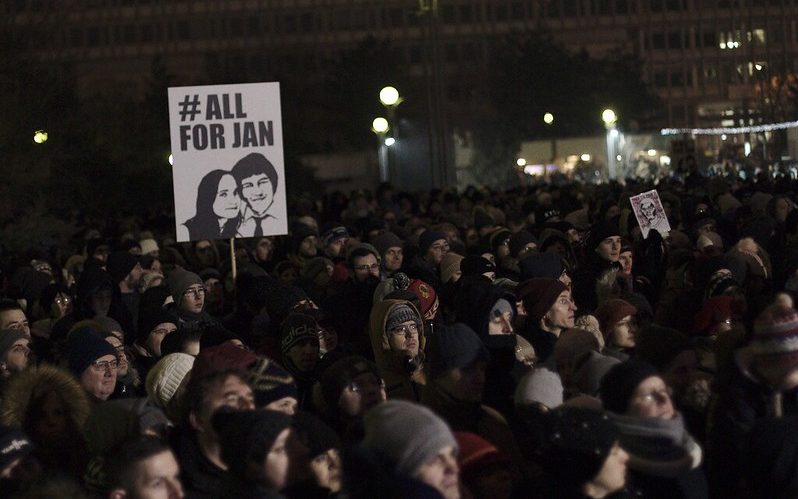
NAKA’s November detentions are however part of a bigger picture. In 2018, Slovakia infamously made the headlines when the investigative reporter Ján Kuciak and his fiancée Martina Kušnírová were murdered in their house on February 21. The investigation of the case revealed corruption perpetuating even the highest levels of the state institutions, supported by Kuciak’s disturbing findings on Marian Kočner’s corruptive oligarchic behaviour. Country-wide protests and a major political earthquake followed. The then Deputy Prime Minister and Minister of Interior Robert Kaliňák and Prime Minister Robert Fico from SMER-SD (Direction – Social Democracy), the strongest party in the Slovak political scene in 2006-20201, were forced to resign. A battle for the future of Slovakia’s democracy and dignity began.
In 2019, the anti-corruption lawyer and environmentalist Zuzana Čaputová became the country’s first female and liberal president in a region labelled as ‘backsliding on democracy’ (Ágh, 2016), when she defeated the European Vice-Commissioner Maroš Šefčovič supported by SMER-SD. The 2020 parliamentary election followed a similar pattern. After twelve years of dominance, SMER-SD was defeated by Igor Matovič’s OĽaNO (Ordinary People and Independent Personalities).
The Kuciak case has become the most followed legal case in Slovak history (Slovak Spectator, 2020). On September 3, the Special Criminal Court of the Slovak Republic found the businessman Marian Kočner and Alena Zsuzsová, linked to have close contacts with country’s elites, not to be guilty of ordering Kuciak’s murder. Though Kočner was found to order the surveillance of several journalists, including Kuciak, Kočner and Zsuzsová were not found to have a motive to plan the murder. The case has moved to the Supreme National Court.
Abuse of power – Nothing new in Slovakia
Unethical behaviour, corruption even on the highest levels and abuse of power is not a new trend in Slovak politics. The suspected negative informal networks have been accompanying the development of Slovak democracy since 1993. The establishment of the formal EU democratic institutions in the country did not impede the continuing growth of informal network body within the state. The Slovak democracy has been constantly hit by revealed scandals of clientelism and oligarchic captures of the state even after the accession to the EU, leading to the erosion of its quality.
Slovak public has become highly perceptive to these trends. According to the Globsec (2019) study, only 38 percent of respondents are satisfied with how democracy works in Slovakia and 85 percent of Slovaks agree that oligarchs and financial groups have strong control over the Slovak government. The latest Eurobarometer study demonstrates further that 52 percent of Slovaks think that the level of corruption totally increased, and 30 percent of respondents think that it remained the same since 2017.
In 2004, a classified document called “Gorilla” was leaked to Slovak media, containing information about the existing clientelist relations among Slovak political elites. After sixteen years of investigation, the Gorilla case remains to be unsolved. So, what has changed since then?
#AllForJan
The latest arrests of former NAKA and police high-ranked officials demonstrate yet again that the corruption practises are bigger than the Kuciak case primarily revealed. The Purgatory operation on the crime links between another Slovak oligarch Norbert Bödör and the group of Tibor Gašpar raise the question of SMER-SD’s political responsibility. Dušan Kováčik, who faces charges of being responsible for “cleaning” the cases in favour of SMER-SD, already notified the Office of the Supreme Prosecutor of his resignation from the post (The Slovak Spectator, 2020).
It appears that not much has changed in the behaviour of Slovak political elites. The Slovak public is yet to forgive the price which the young investigative reporter and his fiancée had to pay. The message of the current events in Slovakia however remains clear. Today, two years after the murder of the young couple, Tibor Gašpar was taken into custody by the police body he himself created, giving hope to the future of Slovak democracy. The evidence from Slovakia thus demonstrates the need of restoration of rule of law in the region and its protection.
Sources
Ágh, A. (2016) ‘The Decline of Democracy in East-Central Europe: Hungary as the Worst-Case Scenario’, Problems of Post-Communism, 13 (5-6), pp. 277-287.
European Commission (2020) Special Eurobarometer 502 – Corruption. Brussels: Directorate-General of the European Commission.
Globsec (2019) Voices of Central and Eastern Europe. Available at: https://www.globsec.org/wp-content/uploads/2020/06/Voices-of-Central-and-Eastern-Europe-read-version.pdf (Accessed: 16 November, 2020).
The Slovak Spectator (2020) ‘Former top police officials taken into custody’, 9 November. Available at: https://spectator.sme.sk/c/22530718/former-top-police-officials-taken-into-custody.html (Accessed: 16 November, 2020).
The Slovak Spectator (2020) ‘Kuciak murder verdict: Kočner and Zsuzsová not guilty’, 3 September. Available at: https://spectator.sme.sk/c/22460393/kuciak-murder-case-trial-verdict.html (Accessed: 16 November 2020).
The Slovak Spectator (2020) ‘Prominent prosecutor charged and suspended’, 23 October. Available at: https://spectator.sme.sk/c/22517177/prominent-prosecutor-charged-and-suspended-kovacik-detained.html (Accessed: 16 November, 2020).
Valček, A. (2020) ‘Kočner had no motive. The written Kuciak case verdict is a surprise’, The Slovak Spectator, 7 October. Available at: https://spectator.sme.sk/c/22504908/kuciak-murder-case-written-judgment-analysis.html’ (Accessed: 18 November 2020).



Be First to Comment