
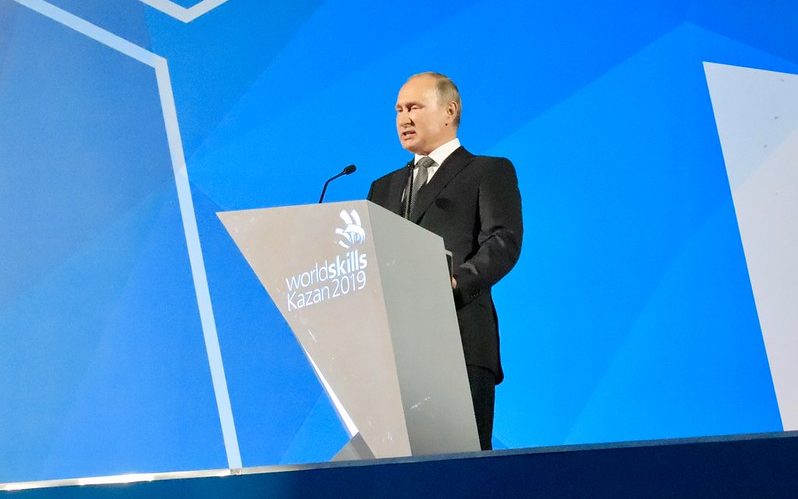
From today’s point of view, Putin’s authoritarian regime is very interesting, to put it bluntly. This dictatorship is characteristic of almost all totalitarian and authoritarian regimes of the twentieth century. Similarly, Mussolini, Stalin, Franco, Hitler may be mentioned as dictators in the theoretical literature.
In modern times, the dictatorial regime of Saddam Hussein in Iraq, of Gaddafi in Libya and others had tragic endings. Unfortunately, for now, Putin’s rule does not resemble any other: it has its own tactics and kept him in power for more than two decades. For example, recall how he played Dmitry Medvedev’s presidency. In fact, we all know that Medvedev was just a puppet in this game, and behind the scenes stood the real ruler, Putin himself. However, Putin did not bother to hide all this.
Before the start of the G20 summit in 2019, the Financial Times conducted an extensive interview with Russian President Vladimir Putin in the Kremlin, in which he made the clear statement that liberalism had exhausted itself. He is convinced that one of the reasons for the alienation between the population and the elite in the West is the liberal ideology, the “dictatorship” which was practically established everywhere, both in the media and in real life. Putin also shamelessly said that his Western colleagues had acknowledged that some elements of liberalism, such as multiculturalism, and others, were simply unrealistic (Financial Times, 2019).
This was followed by sharp criticism from Western colleagues. EU Council President Donald Tusk was the first to respond to Putin’s anti-liberal rhetoric, arguing that Europeans should firmly and unequivocally defend and develop liberal democracy (Gotev, 2016). Those who claim that liberal democracy has become obsolete also claim that freedom, the rule of law, and human rights have become obsolete (Cheung, 2019). And finally, Tusk added that he considers authoritarianism, the personality, the cult, and the rule of the oligarchs, as obsolete (Barber, 2019). That was Tusk’s sharp response.
At the end of the discussion on this topic, Putin states that in terms of human customs and morality, traditional values are more stable and important to millions of people than the liberal idea that fulfils existence (Financial Times, 2019). This part from Putin’s interview indicates what the Russian president meant: attacking liberalism and proving its end is the same as attacking the West and proving its end.
At the same time, the Russian president also indirectly emphasized that liberalism is categorically opposed to traditional values because it leads to their disappearance. This argument is one of the main Russian narratives. The Kremlin aims to make Russia the foremost defender of traditional values in an artificially created information field through powerful propaganda in order to increase its influence in the international arena. The focus on traditional values, as opposed to liberalism, has been particularly prominent in Russia’s political agenda in recent years. At the same time, it should be noted that this direction of Russian propaganda is rather aimed at post-Soviet countries. Against this background, it is not accidental that the issue of protection of traditional values is gradually becoming more and more relevant for Georgia, which is confirmed by the recent activation of certain groups on this topic. For example, the so-called troll mechanism has become very active, the long-dormant nationalist spirit has awakened in the country, which often and unfortunately turns into hand-to-hand violence, thus harming not only the citizens but also damaging the image of the country in the international arena.
In general, Russian propaganda has gained some popularity in civil society and other areas of state institutions, although the scale of this popularity is much smaller than Moscow would have liked. All of this, as mentioned above, is targeted at post-Soviet countries, where it is relatively easy to produce and implement this propaganda. That is why the Kremlin finds it difficult to carry out the same campaign in any European state. Take, for example, the 2007 cyber-attack on Estonia, which was so powerful that it took the country two full days to return to normalcy. What did we get as a result? The increase of anti-Russian attitude and today Estonia is in the top five in terms of cyber-security in the world. Last year, a cyber unit was added to the Estonian army. This is a clear example of what you can do when you become the target of an enemy.
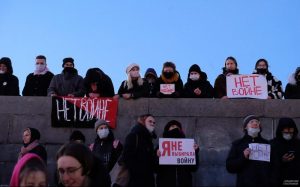
Exactly 20 years have passed since Boris Yeltsin nominated Vladimir Putin for the post of Prime Minister. In terms of domestic politics, he created a dictatorship where all power is in the hands of the regime. The power of this regime lies in one person. The redistribution of power in Russia has disappeared since 1993 when Yeltsin destroyed the Russian Parliament. Putin has completed this process. He has eliminated all independent centers of power. The main “achievement” of the regime is the suppression of dissent, and of independent and free spaces. He managed to take power into his own hands. It completely destroyed the civil institutions and left nothing to be said about free media and the rule of law.
In summary, we can say that, if Russia ever steps on the path to democracy, it will have to go through all the stages that other countries have gone through meanwhile. There is no understanding of human rights, law, free media in the country. That is why his regime is threatened not only by the existence of all this but also by the provision of information on these issues to the population.
Sources Financial Times. (2019, June 27). Transcript: ‘All this fuss about spies … it is not worth serious interstate relations’. Interview with Vladimir Putin. https://www.ft.com/content/878d2344-98f0-11e9-9573-ee5cbb98ed36 Barber, L. et al. (2019, June 28). Vladimir Putin says liberalism has ‘become obsolete’. Financial Times. https://www.ft.com/content/670039ec-98f3-11e9-9573-ee5cbb98ed36 Cheung, H. (2019): Is Putin right? Is liberalism really obsolete? BBC. https://www.bbc.co.uk/news/world-europe-48798875 Gotev, G. (2016, October 14). Tusk: Europe’s anti-liberals look up to Putin and support Trump. Euractiv. https://www.euractiv.com/section/global-europe/news/tusk-europes-anti-liberals-look-up-to-putin-and-support-trump/


Be First to Comment