
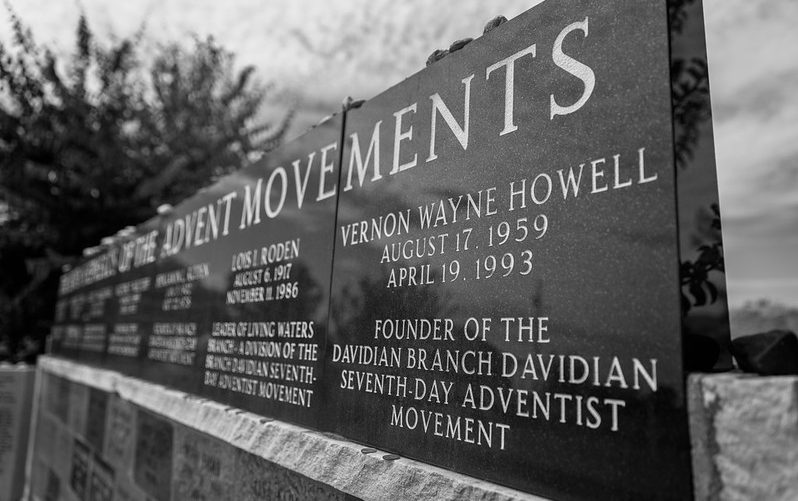
Waco. More than likely, the first thought that comes to one’s mind of this Central Texas city is not that it is the birthplace of the soft drink Dr. Pepper or the home of Baylor University, but rather it is the siege that took place on the outskirts of the city in 1993.
In 1993, federal agents with the Bureau of Alcohol, Tobacco, Firearms, and Explosives (ATF) serving search and arrest warrants for a fundamentalist Christian cult known as the Branch Davidians became involved in a firefight which developed into a nearly two-month long siege with the Federal Bureau of Investigation (FBI) at the helm, ending in the deaths of 76 Branch Davidians. The event itself galvanized the public and changed the entire right-wing movement forever, being seen as one of the main inciting points for the entire right-wing and the militia movement.
The Siege
Waco remains among the most controversial uses of police force in U.S. history and, at the time, was hotly debated.
The Branch Davidians had long been a staple of Waco, Texas being founded in the mid-1950s as an apocalyptic offshoot of the Seventh Day Adventist Church. In the 1980s, amidst a power struggle between the founder’s son, George Roden, and a young convert to the religion named Vernon Howell, both of whom claimed they were the rightful heir and the messiah, Howell was able to seize power by violent means, resulting in Roden’s imprisonment.
Howell, who also went by the name David Koresh to assert religious legitimacy, eventually changed the entire direction of the organization to one that more heavily focused on imminent destruction. Koresh went about exercising “his new authority by taking several “spiritual” wives from among the group’s unmarried members [asserting] he was the perfect mate for all female members and confided to the Davidians his intention to create a new lineage of children who he believed would eventually rule the world”. Many of these wives were also underage, some as young as ten according to victim testimony in front of Congress.
However, what drew the eyes of the U.S. federal government was when the McLennan County Sheriff’s Department asked the “ATF to investigate possible federal gun violations in May 1992, after a UPS driver reported delivering big shipments of gun parts, ammo, grenade hulls and chemicals and military gear to Koresh and his followers” alongside “reports of explosions and automatic gunfire at” the Branch Davidian compound. On February 28th of 1993, the ATF launched a 70-man raid on the compound and, while it is still hotly debated who fired the first shots, “during the two-hour battle, four federal agents were killed and more than a dozen injured” with six Branch Davidians dead.
With this, the FBI entered the event, taking over from the ATF, and resulted in a siege. For nearly two months, during complex negotiations which were hindered by a political desire to end the siege quickly and safely, the Bureau tried “various strategies, including turning off the compound’s electricity, playing Tibetan chants over loudspeakers, and shining spotlights on the complex” all in an effort to get Koresh and his Davidians to surrender. While the FBI did succeed in getting some children out of the compound, Koresh eventually halted the process and remained inside the compound with a total of 76 followers and children.
On April 19, 1993, around 0600, close to two months from when the siege began, the FBI, using armored vehicles, began “punching holes in the building and sending tear gas inside”; around midday, a fire broke out in the compound “and 76 of the 85 Branch Davidians, including Koresh and a number of children, were killed”. According to the autopsy report, Koresh had a fatal gunshot wound to the head while “a 3-year-old boy who was fatally stabbed in the chest and two other minors who suffered fatal blows to the head”.
After many federal investigations, conducted from 1993 to 2000, the official position of the U.S. government was “that federal agents did not start the fire, direct gunfire at the complex, or improperly employ US armed forces. Danforth assigned responsibility for the tragedy to the Branch Davidians and David Koresh” ultimately laying the blame on Koresh’s Davidians but also finding that the Bureau’s “negligence [in timely revealing information] was at best a mishandling of evidence, and at worst a criminal attempt to conceal the truth from investigators”.
This, predictably, did nothing to assuage right-wing or anti-government, militia types and has resulted in decades of allegations that the government played a further role in the event, deliberately killing or murdering individuals or otherwise directly causing the deaths of nearly 80 people.
In all areas of society, Waco remains highly misunderstood and (in some cases) distorted, with more recent media works still propagating myths or doubts about the event.
Why Waco Still Matters
With Waco, it is important to remember how this incident came about and the lessons that can be learned from it. Certainly, the ultimate blame for the event lies at the feet of David Koresh; he was the individual in complete control of the situation and had the strongest hand. At any point during the siege, he could have surrendered himself and gone to trial, quite possibly being able to beat the charges the U.S. government was arresting him on. However, he instead decided to die as a martyr for his cause and take as many Davidians as he could with him, including children. The ultimate blame lies on Koresh’s hands for the outcome of the siege.
This being said, additional blame can be placed on U.S. federal law enforcement and other parties for being contributing factors to the siege’s outcome. The ATF and the FBI both made several mistakes, from intelligence handling and bureaucratic issues on the ATF’s side to a conflict between the tactical and negotiation part of handling the siege, which exacerbated the issue and did more to harm a positive outcome rather than contribute to one.
These failures contributed to the end result and reflected poorly upon the agency as a whole while also increasing the belief many on the political right had that the U.S. government was an adversarial power and was unnecessarily (and illegally) exerting force upon individuals for their religion and right to bear arms. The Waco siege directly resulted in the 1995 Oklahoma City bombing and a clear line of extremism, destruction, and misinformation can be traced from Waco to the 1996 Centennial Olympic Park bombing, the creation of the Oath Keepers, the 2017 Unite the Right rally, culminating in the 2021 coup attempt at the U.S. Capitol building.
The Waco Siege remains burned, literally and figuratively, into the public’s memory, being an important, watershed moment in American politics and society, primarily on the topic of government overreach, religious extremism, and the right to bear arms, intertwining various areas that ring true for the right-wing.
The trend of right-wing politics, ideology, and rhetoric in American politics has become increasingly common and all the more mainstream. Today, the Republican party is no longer the party of John McCain, Mitt Romney, or George H.W. Bush, the establishment, more middle-of-the-road Conservative ideology; it is defined now by individuals like Marjorie Taylor Greene, Greg Abbott, Lauren Boebert, and Ron DeSantis, dominated by Conservative extremists in thought and those who support many (if not all) of the incredibly racist and harmful policies advocated by the Trump administration.
That is the greatest legacy of the Waco siege, the changing of the conservative movement in the United States into one that has become largely dominated and controlled by extremist parties who do not have an interest in making medially or statistically informed policy, but rather appealing to their own base and ideology. The violent, religious-based and 2nd amendment-focused Conservatives who had been ostracized from the mainstream and had been featured only on the margins of the Republican Party have become those at the helm of the entire Party and U.S. Conservative movement.
That is the longest-lasting and, socially, the most important legacy from the siege at Waco thirty years ago.
Submit here
Be First to Comment