
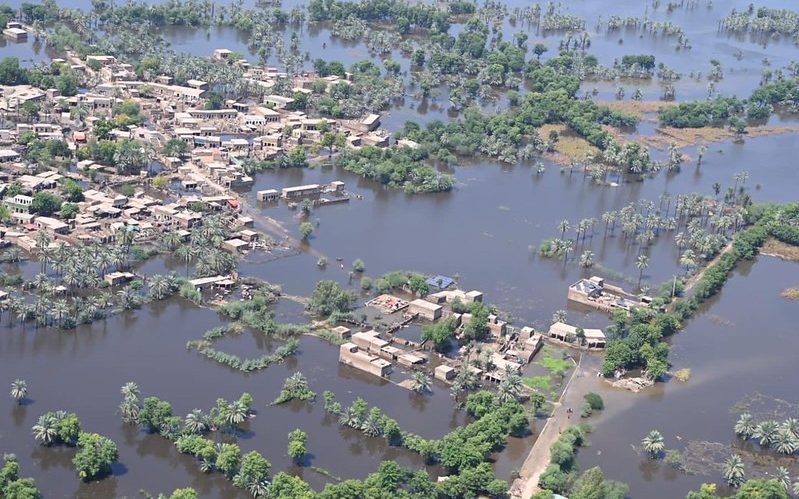
Pakistan was hit by devastating floods in 2022 inflicting massive losses and damages. This sparked a pressing demand for climate change justice as the country sought fair treatment in addressing the impact of climate change on its people and land emphasizing the historical responsibility of the Global North and the fair distribution of environmental challenges. Pakistan, contributing less than 1% to global emissions, becomes a tragic example of vulnerability, burdened by the consequences of emissions not of its making.
The toll of the loss and damage from the 2022 floods was assessed to be approximately $30 billion. A mammoth $16 billion was estimated for flood recovery by Post Disaster Needs Assessment (PDNA).
Approximately 15,000 lives were lost or affected, and 8 million people were displaced, with significant damage to homes, infrastructure, and agricultural land. The aftermath left over 2 million homes destroyed, 13,000 kilometers of highways damaged, 439 bridges collapsed, and more than 4 million acres of agricultural land in ruins. The economic impact was dire, with an estimated 9 million individuals facing the risk of falling into poverty due to the catastrophic floods.1 Two important developments post COP 27 invigorated Pakistan’s case for climate justice as a vulnerable state to climatic changes induced disasters. Firstly, the announcement of a Loss and Damage Fund for vulnerable countries post COP 27 and secondly, the pledges received in the Geneva donor conference hosted by Pakistan.
The Geneva International Conference on Climate Resilient Pakistan was Co-hosted by the Government of Pakistan and the United Nations in Geneva, Switzerland on the 9th of January 2023. This conference pledged $9 billion for Pakistan.2 But these pledges have not materialized as we would’ve hoped so.
The Loss and Damage Fund’s establishment post-COP 27, appeared to be another beacon of hope, but it fell short as it was not operationalized until COP 28 in late 2023, this left Pakistan grappling with unmet financial needs since the 2022 floods, mere promises, and pledges, underscored a failure to address the moral responsibility owed to vulnerable countries like Pakistan. The devastating losses and damages unravelled the impact of prehistoric versus postindustrial emissions. This signified Pakistan’s burden as a victim of historical emissions from the Global North. The role of extreme rainfall patterns was also pivotal in making matters worse with unprecedented rain pouring down through the summer of 2022. This scenario emphasized the unjust struggles faced by Pakistan due to emissions beyond its control.
The operationalization of the Loss and Damage Fund in COP 28 with $700 million in pledges marked a positive step. However, critics argue it is insufficient for meeting the needs of vulnerable countries like Pakistan. also underlining the pivotal need for urgent reforms, transparency in financing, concrete progress on implementation of pledges and international accountability at next year’s COP 29. There is a lack of urgency from Global North states to address climate change justice and secure Pakistan’s fair share of reparation to foster climate resilience and funding for mitigation/adaptation projects.
Notably the Loss and Damage Fund from the Global North, fell short of its moral responsibility, leaving Pakistan with unmet financial needs for recovery and building climate resilience. These unfulfilled promises unfortunately, expose the failure of the international community to meet its moral obligations.
The climate justice argument is based on the UN Framework Convention on Climate Change’s Common but Differentiated Responsibilities Respective Capabilities CBDR-RC principle through which states like Pakistan that are vulnerable to extreme weather resulting in climatic changes demand reparations and climate finance. In the current scenario, the argument of Pakistan’s right to climate change justice is strengthened by the UNFCCC’s Common but Differentiated Responsibilities Respective Capabilities (CBDR-RC) principle. Moreover, Pakistan’s vulnerability, contributing just less than 1% to global emissions, and the role of extreme rainfall patterns in exacerbating the impacts of climate change showcases Pakistan is bearing the brunt of emissions not of its making.
Looking ahead to COP 29, it is crucial to highlight the growing gap in finance and the need for urgent reforms. The lack of specifics on financing in previous agreements sets the stage for finance to become a pivotal issue in future COPs. In the face of this looming financial gap, there is a pressing need for implementation, accountability, and climate justice. COP 29 becomes a crucial arena for addressing climate change justice and holding big emitters accountable. Stressing the importance of lobbying for Pakistan’s fair share of reparation, increased resilience, and funding for mitigation/adaptation projects is imperative. The government must continue to engage with all relevant stakeholders to ensure a successful transition from pledges to implementation. The narrative of climate justice for Pakistan must persist to secure a sustainable and equitable future in the face of the escalating challenges posed by climate change.
Submit here
unfccc.int. “COP28 Agreement Signals ‘Beginning of the End’ of the Fossil Fuel Era,” December 13, 2023. Accessed December 18, 2023. https://unfccc.int/news/cop28-agreement-signals-beginning-of-the-end-of-the-fossil-fuel-era.
Anand, Akriti. “COP 28 Deal: How Impactful It Is Likely to Be and What to Expect from COP 29 | Mint.” Mint, December 15, 2023. https://www.livemint.com/news/world/cop-28-deal-transition-away-from-fossil-fuel-how-impactful-it-is-likely-to-be-what-to-expect-from-cop-29-11702483221799.html.
Legal Response International. “Legal Response International » Common but Differentiated Responsibilities and Respective Capabilities (CBDRRC),” n.d. https://legalresponse.org/legaladvice/the-principle-of-common-but-differentiated-responsibilities-and-respective-capabilities-a-brief-summary/.
“Pakistan: Flood Damages and Economic Losses Over USD 30 Billion and Reconstruction Needs Over USD 16 Billion – New Assessment.” World Bank, October 28, 2022. https://www.worldbank.org/en/news/press-release/2022/10/28/pakistan-flood-damages-and-economic-losses-over-usd-30-billion-and-reconstruction-needs-over-usd-16-billion-new-assessme.
“Pakistan Climate Change: One Third of the Country Is Underwater.” Open Access Government, September 17, 2022. https://www.openaccessgovernment.org/pakistan-climate-change/142864/.
Jazeera, Al. “Donors Pledge More than $9bn for Pakistan Flood Recovery.” Al Jazeera, January 10, 2023. https://www.aljazeera.com/news/2023/1/9/flood-hit-pakistan-hosts-climate-resilience-meet-with-un-for-aid.
Office, Spokesperson. “International Conference on Climate Resilient Pakistan Geneva, 9 January 2023.” Ministry of Foreign Affairs, January 9, 2023. https://mofa.gov.pk/international-conference-on-climate-resilient-pakistan-geneva-9-january-2023/.
Handley, Eskarina. “Pakistan Climate Change: One Third of the Country Is Underwater.” Open Access Government, September 17, 2022. https://www.openaccessgovernment.org/pakistan-climate-change/142864/.
Rannard, By Georgina. “How Pakistan Floods Are Linked to Climate Change.” BBC News, September 2, 2022. https://www.bbc.com/news/science-environment-62758811.
UN HABITAT PAKISTAN. “UN HABITAT PAKISTAN COUNTRY REPORT 2023.” UN Habitat Pakistan, June 4, 2023. Accessed November 9, 2023. https://unhabitat.org/sites/default/files/2023/06/4._pakistan_country_report_2023_b5_final_compressed.pdf.
- UNDP “International Conference on Climate Resilient Pakistan,” UNDP, n.d., https://www.undp.org/international-conference-climate-resilient-pakistan [↩]
- Al Jazeera, “Donors Pledge More than $9bn for Pakistan Flood Recovery,” Al Jazeera, January 10, 2023, https://www.aljazeera.com/news/2023/1/9/flood-hit-pakistan-hosts-climate-resilience-meet-with-un-for-aid [↩]




Be First to Comment