
This article was initially published on Sara’s medium account. You can also find it here: https://sarahpanhwar.medium.com/climate-change-and-its-impact-on-poorer-communities-in-karachi-the-flaws-in-urban-architecture-95fdbd893535
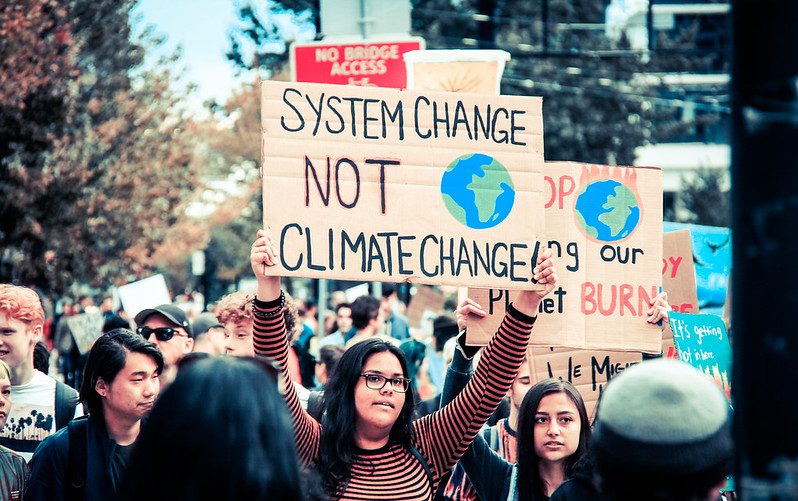
There is no doubt that climate change today has become one of the many threats to our environment. From being seen as a menace to the wildlife and especially polar bears in the north pole, as a result of the melting of the ice in the 1990s, climate change has had a severe impact on humankind today. Be it the Paris Agreement or the United Nations Framework Convention on Climate Change, the irreversible effects of climate change have led to several international treaties over time. However, the process of climate change is not as black and white as it is seen; there are many grey areas to it. When probed into the deadly effects of climate change, researchers found several factors that impede greenhouse gas (GHG) mitigation. One factor that is adding to climate change is urban infrastructure. It is measured through empirical data, that the material used in the construction of commercial buildings and houses, such as concrete, cement, steel, asphalt, glass, brick, stone, etc., is single-handedly harming the urban ecosystem.
Urbanized cities, towns, roads, flyovers, etc., absorb heat, store it and release it, making them significantly warmer than other areas or cities. Such areas are known as Urban Heat Islands (UHI), a term coined in the 1810s by English chemist Luke Howard. The term island is used for such areas because, while their surroundings have average temperatures, these target areas tend to be much hotter. Historically, it is seen that the UHI phenomenon tends to increase energy consumption, leading to more heat emissions. Not only does this increase in emission affect the heat island itself, but it also has a significant impact on its surroundings. The temperature difference between the rural and urban areas depends upon “how well the surfaces in each environment absorb and hold heat” (Anwar, 2020). The urban areas that are termed as heat islands tend to be their namesakes throughout the year, although the effect is noticed more in summers and harsh winters. Nights in heat islands tend to be hotter because the heat is trapped inside the building material.
Karachi and the UHIs
The eleventh-largest city in the world and home to over 20 million people, Karachi, is not immune to extreme heat waves. The hot spell of 2015 led to the death of over 2000 people in the month of Ramadan. Compounded by load-shedding, complete power outages, extreme poverty, and poor living conditions, it is undoubtedly the underprivileged areas and communities of the city that are affected the most. This article, therefore, aims to dig deep into the housing conditions of some of the underdeveloped areas of the city like Ibrahim Hyderi, Korangi, Machhar colony, etc., to unfold the challenges faced by the communities living in these areas. Using different researches and policies, this essay will also attempt to provide at least temporary, if not permanent, solutions to the UHI phenomena and how to mitigate it.
When it comes to Pakistan, Karachi is the city that witnessed the most deaths during the heat waves of 2015. However, there are hotter cities than Karachi, yet they were not as affected. This is predominantly because “rapid urbanization and global warming have inflicted the UHI effect on the city” (Anwar, 2020). In urban heat islands, heat is trapped at the lowest levels as a result of the construction material. Quite contrary to rural or green spaces, when the heat strikes the urban buildings, only some of it reflects back, and most of it is trapped. This leads to an increase in room temperature, hence the need for air coolers, air conditioners, and refrigerators, which in turn add more to climate change and GHG emissions. Moreover, most buildings in UHIs are painted with dark colors, commercial offices tend to have enlarged glass windows, and there are virtually no trees in UHIs in Karachi. Amidst this chaos, it is the underprivileged, the ones living below the poverty line, who cannot afford proper cooling systems or backup power supplies, that are affected the most.
UHIs also have an extraordinary impact on the health of the surrounding areas. In Karachi, Ibrahim Hyderi is one of the slums. Underprivileged and needy, the livelihoods of the people in Ibrahim Hyderi depend on fishing. Due to the lack of basic facilities, i.e., education and healthcare, fishing is the only source of income for most people. As a result of global warming and the heat island effect, the habitants are more prone to be at risk of the dengue epidemic, malaria, chikungunya, etc. When researchers studied the phenology (the study of periodic events in biological life cycles) of odonates and flying insects, they found “the impact of climate change on the phenology of odonates is explained by the fact that their life history is greatly influenced by temperature (Hassall and Thompson 2008)”. The rising temperature increases embryonic development’s success and accelerates the growth rate of larvae, multiplying their population predominantly because insects tend to be exothermic. In 2017, most underprivileged areas of Karachi, such as Ibrahim Hyderi, Orangi Town, Bin Qasim, Surjani, Lyari, etc., were filled with patients showing symptoms of the mosquito-borne Chikungunya viral infection. (Bhatti, M.W., 2017)
What Next?
As a country that adds the least to the GHG emissions and the resulting climate change, Pakistan is considered one of the countries hit hardest by it. As a result of the decline in snowfall and glacial accumulation due to global warming, there’s an impediment in the flow of the water of the river Indus (Hasnain, 2010). Change in the seawater temperature has a direct impact on the marine fish web and the underwater ecosystem. It threatens their lives and the lives of the people dependent on fishing. Moreover, different studies have collected data “on the relationship between the urban heat island, its associated thermal conditions, and mortality in Asian and Australian cities” (Tan, J. et al., 2010), and they concluded that the UHI phenomenon could exacerbate the mortality rate. In a 30-year long study of Shanghai, an “almost linear relationship between UHI intensity and the excess mortality rate was demonstrated” (Tan, J. et al., 2010). There are many workers who work in industrialized areas in Landhi and Korangi, which are some of the UHIs in Karachi, and these industrial areas get extremely hot at night, reported by a worker in a labor commune inside Ilyas Goth. These underlying problems can be avoided by providing a solution to the UHI phenomena in urbanized areas.
There are four outdoor strategies to mitigate the UHI phenomena and its sundry effects. Those strategies are “(1) albedo modification to have better thermal properties of building and construction materials in urban areas; (2) application of greenery; (3) better urban ventilation; and (4) environmental management” (Rehan, R.M., 2016). In a study by Falasca and Curci on the impact of highly reflective materials on meteorology in Milan, Italy, it was seen that by increasing the albedo effect in the urban areas from 0.2 to 0.7, the UHI temperature decreased by 1–2 degrees celsius (Yang, J. & Santamouris, M., 2018). This shows that by using the technology and modifying the infrastructure to make it more climate-friendly, the overall temperature can be decreased and the many problems that come with it.
Sources Bhatti M.W. (2017), The News, Chikungunya epidemic spiralling out of control in Karachi. https://www.thenews.com.pk/print/201106-Chikungunya-epidemic-spiralling-out-of-control Center for Strategic and Contemporary Research (2020): Pakistan’s Urban Heat Islands, https://cscr.pk/explore/themes/energy-environment/pakistans-urban-heat-islands/ Hasnain, S. (2010), Express Tribune, What do fish have to do with climate change? Rehan, R.M. Cool city as a sustainable example of heat island management case study of the coolest city in the world. HBRC J. 2016, 12, 191–204. Tan, J.; Zheng, Y.; Tang, X.; Guo, C.; Li, L.; Song, G.; Zhen, X.; Yuan, D.; Kalkstein, A.J.; Li, F.; et al. The urban heat island and its impact on heat waves and human health in Shanghai. Int. J. Biometeorol. 2010, 54, 75–84. The News International (2017): ‘Chikungunya epidemic spiralling out of control in Karachi’, https://www.thenews.com.pk/print/201106-Chikungunya-epidemic-spiralling-out-of-control Villalobos-Jiménez, G., Hassall, C. Effects of the urban heat island on the phenology of Odonata in London, UK. Int J Biometeorol 61, 1337–1346 (2017). https://doi.org/10.1007/s00484-017-1311-7 Yang, J. & Santamouris, M. (2018), Urban Heat Island and Mitigation Technologies in Asian and Australian Cities — Impact and Mitigation, MPDI
https://tribune.com.pk/article/108/what-do-fish-have-to-do-with-climate-change




Be First to Comment