
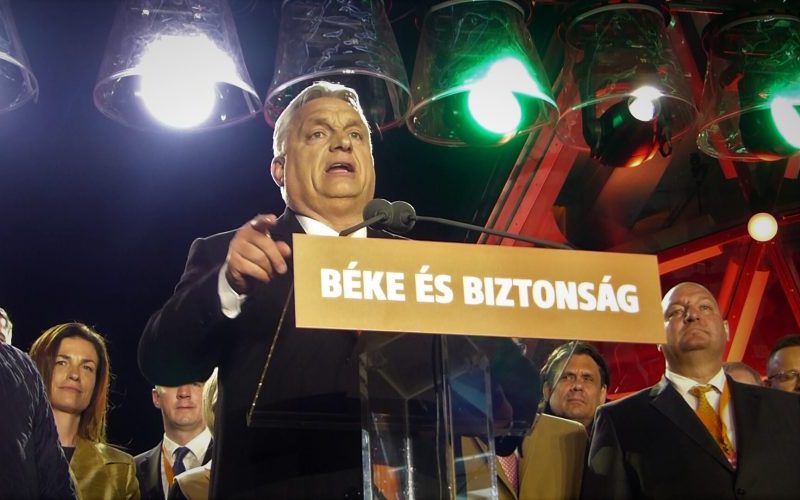
Over a year ago, Viktor Orbán, Europe’s biggest headache and strongman in Hungary, and his Fidesz party were re-elected for the fourth consecutive time. For the first time in the country’s history, a united opposition tried to bring down Orbán’s regime – to no avail. Due to the corrupt system that Orbán has built over the past 13 years in power – including Gerrymandered districts and a skewed media landscape that works in his favour – the Fidesz party won with an overwhelming majority and was able to further consolidate its power in the country.
While Orbán’s win was, in general, not all too surprising, the overwhelming two-thirds majority that the party received and the two gained seats in parliament, were as most polls before the elections predicted a closer race between Fidesz and the united opposition. However, the overlooked factor in these was the role Russia’s invasion of Ukraine would play in the re-election of Orbán. After all, the new geopolitical circumstances and the changing of Europe’s security landscape helped Orbán present himself as an experienced leader who would bring political stability in uncertain times.
Since Russia’s full-scale invasion of Ukraine and the re-election of Fidesz almost one and a half years ago, Orbán, politically and rhetorically savvy as he is, continuously takes advantage of the current circumstances and instrumentalises Russia’s ongoing war in Ukraine for domestic political gains.
Shifting the blame
Since the start of Russia’s war on Ukraine in February 2022, the European Union has been swift to prepare ever more extensive sanctions packages against Russia to undermine its ability and willingness to wage war on its neighbour. Although Hungary has tried to use sanctions as a bargaining chip by attempting to water them down and exempt certain individuals while threatening to veto their adoption, they always ended up voting in favour of them in the European Council – even if so reluctantly.
Nonetheless, from the Hungarian government’s official communication on the matter and its representation in the media, it seems as if, despite Hungary’s strict opposition to the sanctions, they were imposed by Brussel’s elite without the country’s approval. This representation is clearly misleading and wrong: all restrictive measures adopted – thus far ten packages since February 2022 – were approved by Hungary. Moreover, the Hungarian government continues to criticise the EU sanctions, claiming they “failed”.
On the one hand, criticising the restrictive measures and presenting them as a burden imposed by Brussels – a common scapegoat for the Hungarian governing party – helps Orbán shift the blame for Hungary’s dire economic situation away from his own government and to the EU. Thus, with the highest inflation rate in Europe and growing dissatisfaction among the Hungarian population, the prime minister uses Brussels once again as the fall guy for all ills. And even though other EU countries also face high rates of inflation due to an accumulation of unfortunate circumstances – first, the pandemic, now the war in the neighbourhood – Orbán continues to pretend that the EU sanctions are the sole reason for the country’s surging inflation. The reality that increased government spending and handouts leading up to the 2022 elections are also to blame – thus the high inflation would partly be due to Fidesz’s own making – is swept under the rug.
On the other hand, with its rhetoric on sanctions as a measure imposed by a constructed elite, the Hungarian government uses “Brussels” as a scapegoat and Hungary as a suppressed nation – and thereby reinvigorates a common historical theme and collective trauma in public discourse to appeal to the Hungarian people.
In addition to its hypocritical, rhetorical opposition to the EU’s sanctions, the Hungarian government regularly refers to the Hungarian minorities living in Transcarpathia, Western Ukraine, a territory formerly belonging to Hungary, as particular victims of this war. According to the narrative spread by Fidesz politicians, these Ukrainian Hungarians are involuntarily drafted into the army and now fight and die in this war. By reiterating how this war negatively affects the ethnic Hungarians in Ukraine, Fidesz politicians portray themselves as “true patriots” and defenders of all Hungarians, at home and abroad. The aim is to bring them sympathy and support from Hungarians at home.
Besides the Hungarian government’s rhetorical opposition to the sanctions, it also continuously reiterates its commitment to “peace” and blames the EU and weapons deliveries to Ukraine for prolonging the conflict and suffering yet, fail to mention the actual aggressor in this war – Russia. Summarised on social media as the “pro-peace camp”, they portray themselves as a “peace force” in Europe, in contrast to the EU and Hungarian opposition politicians who are illustrated as warmongers.
Fidesz also repeatedly presents overly simplistic “solutions” to the war, reiterating that peace negotiations are needed for a way out of the conflict – as if others have not yet tried negotiating with Russia. Domestically, these empty phrases, combined with depicting anyone in support of Ukraine’s victory as a driving force behind the conflict, help them further perpetuate the image of Fidesz as a “peace force” working to protect Hungarians.
Moreover, government NGOs such as the “Szászadvég Foundation” or “Nézöpont Institute” conduct questionable surveys, the results of which are circulated on social media to present Viktor Orbán in a positive light. They are furthermore used to justify and support the governing party’s stance on the war. In the end, these opinion polls merely serve as a tool to publicly demonstrate that the population supports the government’s agenda and are reminiscent of the notorious “national consultations” which have virtually no effect on agenda-setting other than to affirm the idea that the Hungarian population fully supports Viktor Orbán’s politics and policies. In true populist fashion and tradition, with the surveys on the sanctions and the war, they can thus pretend they are acting upon the “true will of the Hungarian people”.
Finally, given Hungary’s skewed media landscape, that is heavily dominated by pro-Orbán government narratives, and the constant reiteration of Fidesz talking points, the party’s views on the war and the EU’s response are further propagated. As Hungarians have little access to alternative narratives on the war, it makes for a beneficial situation for the governing party. They can spread their storyline and disinformation and vilify anybody opposing Fidesz’s approach to Ukraine and the war.
Cui bono?
While the war in Ukraine is ongoing and people are suffering, the Hungarian government shamelessly used it to spread pro-Russian propaganda and to make domestic political gains. With Orbán’s approach to and rhetoric about the war, he positioned himself as the “protector” of the Hungarian nation and Europe as a whole and showcased that his government is, contrary to others, truly working for the interests of the people at home and in Europe. With his reiteration that Hungary will not let others dictate how to conduct its foreign affairs and equating “Brussels” to an empire, he is addressing the historical grievances of Hungary as a nation that was historically suppressed by greater powers. Moreover, his continuous references to ethnic Hungarians in Ukraine that are also affected by this war justify his reluctance to supply weapons as he wants the war to be over soon. Orbán thereby personates the defender of Hungarians at home and abroad, and the fighter for Hungarian interests.
Lastly and crucially, Orbán used the war as a pretext to extend the state of emergency and his rule by decree, which he initially imposed during the coronavirus pandemic – thus giving him more power domestically.
In the end, even if Orbán’s stance on the war in Ukraine alienates him from allies, it brings him sympathy at home. Hence, rather than being a mere pro-Russian actor in the EU and NATO, Orbán is, first and foremost, pro-Orbán – using his political clout where he can, to do what benefits primarily himself and his party.
Submit here




Be First to Comment