
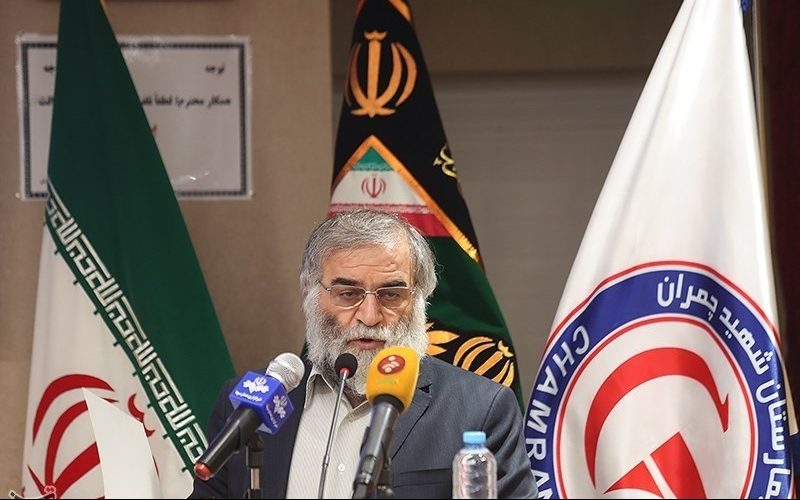
Dr Mohsen Fakhrizadeh, the head of the Iranian nuclear weapons program, was killed near Tehran a few weeks ago. Dr Mohsen Fakhrizadeh was considered to be the father of the Iranian nuclear program and of course, the Iranians immediately blamed the Israelis for the assassination. This comes as no surprise, since these kinds of targeted attacks on Iranian scientists have happened in the past. From 2010 to 2012, there were a series of assassinations targeting nuclear scientists in an effort to hinder the Iranian development of nuclear weapons. Based on the previous events, it is logical for the Iranian regime to conclude that the Israelis are responsible for the death of Dr Fakhrizadeh. Yet, there are a lot of Arab nation-states that also do not want to see Iran as a regional nuclear power. Taking this into account, we can identify a lot of cracks in the Iranian counterintelligence which have allowed these events to unfold.
Brigadier General Hossein Dehghan, a chief military adviser to Iranian supreme leader, even openly said on TV that there are people within the intelligence system who are providing the enemies with information, which might be true. The Iranian regime does have a solid domestic as well as exiled opposition, group called People’s Mujahedeen of Iran (MEK), which has also been blamed for playing a part in the assassination of Dr Fakhrizadeh. That being said, in order to cover up various cracks in the counterintelligence community, the Iranian regime came out with various conflicting reports on how exactly the assassination unfolded.
The first thing the wider audience needs to know is that the IRGC (Iranian Revolutionary Guard Corps) was tasked to protect Dr Fakhrizadeh at all times. One of his bodyguards selflessly placed himself on top of him in an effort to shield him from the array of bullets fired onto the car, a process in which the bodyguard got shot four times. In the aftermath of the shooting, reports came out that a group of shooters opened fire on the car transporting Dr Fakhrizadeh, while a Nissan truck filled with explosives blew up.
The logical question to ask here is how it was possible that the Office of Counterintelligence, which is a part of the Ministry of Intelligence and Security, was unaware of the threats to Dr Mohsen Fakhrizadeh and if there were some indications about a possible assassination attempt, why was the IRGC not notified? A few days after the initial reporting, General Fadavi (deputy commander of IRGC) told the media that the assassination was carried out by a satellite controlled machine gun mounted on the Nissan pick-up truck, which used facial recognition software to lock onto its target.
The Israeli military is known for using these kinds of “smart” remote-controlled machine guns, but if this statement by General Fadavi is true, it is more than embarrassing since it proves that Iranian counterintelligence has failed at their jobs. How is it possible for the Israelis (assuming it was them) to so easily penetrate the country with a machine gun, install it onto a truck, which was probably bought and paid for somewhere within the country, drive that truck to the exact point where one of the country’s most important scientists will be, liquidate him, blow up the truck and escape? This either proves gross incompetence or willful complicity.
The second thing that the audience needs to know is that state-sanctioned assassinations are not simple operations to plan and execute. Targeted killing operations only make sense if they are used as a deterrent or if a certain target is important enough that his/her death would deal a significant blow to the adversary nation-state. To be a target of interest, you have to be irreplaceable. If someone can take your place half an hour after your death and continue your work, assassination is meaningless.
Whoever planned this operation clearly thought that Dr Mohsen Fakhrizadeh was irreplaceable thus worth the risk of possible consequences (in terms of Iranian retaliation) for placing a kill order on his name. This means that, in order for the operation to be successful, operators needed to conduct intelligence gathering. They needed to know Dr Mohsen Fakhrizadeh’s exact movements and daily routines in order to know when and where they would be able to strike. Intelligence gatherings with regard to target movements could have been done via satellite imagery, tracking cellphone signals, having teams on the ground physically following the target or they could have bribed someone within the doctor’s inner circle who is familiar with his schedule and not exactly a supporter of the Iranian regime.
Whatever the strategy used may have been, it was the job of the Office of Counterintelligence to identify these threats and eliminate them. Hence, it was complete operational failure on their part. Iran has vowed revenge, which will most likely follow in some form of a terrorist attack, aided by the Lebanese Hezbollah. I do not believe that US military personnel will be the target of these attacks, because Iran does not want to ruin the possibility of future negotiations with the new Biden administration, which has announced their interest to rejoin the Iran nuclear deal (JCPOA).
I have read some of the political commentaries which say that the goal of this assassination was not to cripple the Iranian nuclear program but to cripple Joe Biden’s chances of getting the Iranians back to the negotiating table for the JCPOA. My opinion is that one does not exclude the other. This targeted killing achieved both of these things. The chief nuclear scientist is off the chessboard and Joe Biden will in fact have a harder time bringing Iranians back to the negotiating table, since the Iranian hardliners will wholeheartedly oppose this idea of renegotiating. Finally, if Iranians ever want to be taken seriously as a regional power, they need to address many of their internal flaws, including the flaws in the counterintelligence sector.
Sources
Aljazeera (2020): Iran: ‘Smart satellite-controlled machinegun’ killed scientist, https://www.aljazeera.com/news/2020/12/7/iran-smart-satellite-controlled-machine-gun-killed-scientist, accessed 15.12.2020
The New York Times (2020): Killer Robot? Assassination of Iranian Scientist Feeds Conflicting Accounts, https://www.nytimes.com/2020/12/02/world/middleeast/iran-assassination-nuclear-scientist.html, accessed 14.12.2020
The New York Times (2020): Iran’s Top Nuclear Scientist Killed in Ambush, State Media Say, https://www.nytimes.com/2020/11/27/world/middleeast/iran-nuclear-scientist-assassinated-mohsen-fakhrizadeh.html, accessed 15.12.2020
Times of Israel (2020): Iran official claims several arrested over nuclear scientist’s killing, https://www.timesofisrael.com/iran-official-claims-several-arrested-over-nuclear-scientists-killing/, accessed 14.12.2020
Times of Israel (2020): Iran accuses exiled dissident group of helping Israel kill top nuclear scientist, https://www.timesofisrael.com/iran-accuses-exiled-dissident-group-of-helping-israel-kill-nuclear-researcher/, accessed 15.12.2020






Be First to Comment