
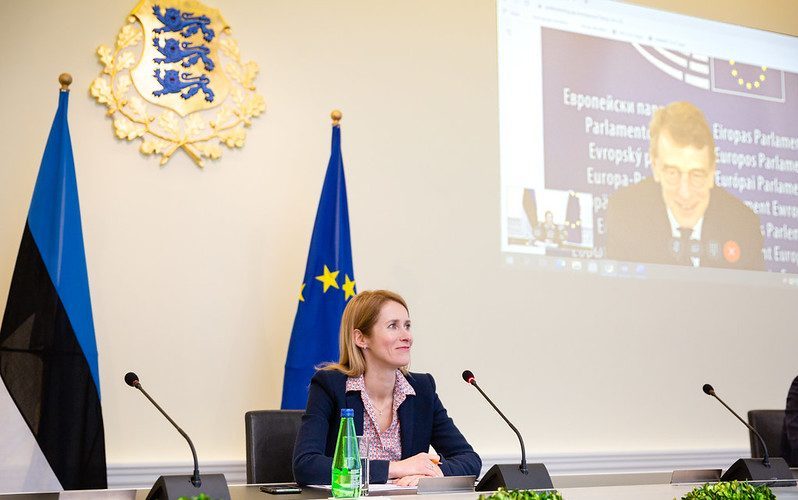
Estonia is the first country in the world that appointed a female president and a female prime minister. Since the previous PM Juri Ratas from the Centre Party (Eesti Keskerakond) resigned after a corruption scandal that implicated his party, Estonian President Kersti Kaljulaid (Independent) appointed Kaja Kallas from the Reform party (Reformierakond) as the first female to be PM in Estonia.
The previous cabinet, led by the Centre Party with the Conservative People’s Party (EKRE) and National-conservative party (Isamaa), was replaced on 26th January 2021 by a more moderate and Europeanist lead by Kallas’ party and the Centre party.
The change has been fast and smooth but not without consequences. In fact, the two parties in the new cabinet had opposite outcomes in terms of support. As expected, the support for the Central party decreased by five percent, while the Reform Party gained six percent. Noticeable is also growing support for the former cabinet’s party EKRE by three percent, which gained support after the scandal and was able to withstand the new surge.
As a first step, the newly appointed government withdrew the marriage referendum, wanted by EKRE and supported by the Centre Party, in the 13th January sitting of the parliament (Riigikogu). It will therefore not be held as initially set in April. This controversial referendum aimed at defining the term “marriage” with the following question to the public: “Should marriage in Estonia remain a union between a man and a woman?”. As a consequence, the delay of the referendum alleviated some internal and international pressure on the government. The Estonians’ public opinion, extremely polarised on the question of the marriage referendum, benefits from the change of government. In terms of international affairs and cooperation, the fact that EKRE left the coalition government has been seen as a necessary viaticum for the country’s rehabilitation in the EU and NATO.
The previous government is remembered for some unfortunate statements against Finnish and American allies: more than once, the ministers belonging to EKRE have made official statements smearing the Finnish PM and also their questioning of the outcome of the US elections has undermined the prestige of Estonia in both, the EU and NATO. Despite these unconventional statements, EKRE’s internal politics received large support, allowing them to achieve what they call “Ekretification” of the country. The Estonian political scientist and professor of comparative politics at Tallinn University, Tõnis Saarts, argues that the process of “Ekretification” of the country cannot be considered a victory for them. Rather, the radical party won some battles. EKRE was definitely able to polarize the discourses in Estonian politics more and more, but their strong conservativism not only negatively affected the relationship with the opposition, but also with the coalition partner.

So, what can we expect from the new coalition government that was formed in January? The first words of the new PM were definitely encouraging from a more liberal and moderate point of view. Kallas’ aim to engage more cordial relationships with the European partners and neighbours after the previous frictions is, undoubtedly, a brilliant starting point for strengthening the support of the party nationally and internationally. In addition, it is likely that the cooperation among Baltic countries could reinvigorate and solidify after having reached the lowest point since the transition period. The new government will definitely take a more strong and internationally supported position for a green strategy and the post-Covid-19 recovery, according to EU directives. We can also assume that Estonia will return to being a more open and free country, following the path that started decades ago and that sharply slowed down due to the previous radical government.
Sources
ERR News (2021): Kallas to European Council chief: New government will cooperate with EU, https://news.err.ee/1608087925/kallas-to-european-council-chief-new-government-will-cooperate-with-eu
ERR News (2021): Ratings: Reform and EKRE gain support after change of government, https://news.err.ee/1608088708/ratings-reform-and-ekre-gain-support-after-change-of-government
ERR News (2021): Tõnis Saarts: The running total of the ekrefication of Estonia, https://news.err.ee/1608086608/tonis-saarts-the-running-total-of-the-ekrefication-of-estonia
ERR News (2021): Riigikogu votes against marriage referendum bill, https://news.err.ee/1608072796/riigikogu-votes-against-marriage-referendum-bill
ERR News (2021): Opinion: Liberal Estonia is Back – but hard lessons have been learned, https://news.err.ee/1608081061/opinion-liberal-estonia-is–back-but-hard-lessons-have-been-learned


Be First to Comment