
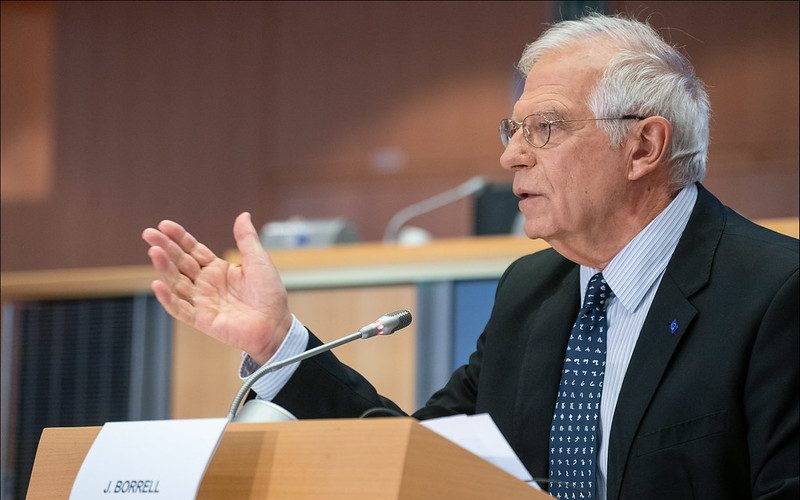
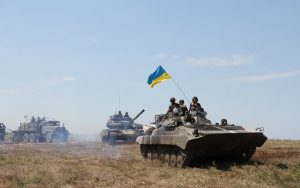
Josep Borell, the High Representative of the Union for Foreign Affairs and Security Policies (HR), concluded his institutional visit to Russia on the 6th February 2021. During his visit, the HR met the Russian Foreign Affairs Minister, Sergej Lavrov, to discuss the future EU and Russia relationship. The core of the discussion was the Russian threat on the Russian-Ukrainian border and the Russian interference in Belarus’ internal affairs. However, Borell also stressed the need for cooperation between the two players and underlined the importance of respect for the Helsinki Final Act. In this sense, the HR wanted to draw the counterpart’s attention on the ongoing human rights violations in Russia and on the developments regarding Alexei Navalny.
What accelerated the EU representative’s visit was the arrest of Navalny, the famous political opposition leader in Russia, who returned to Russia after having recovered in Germany from a Novichok poisoning that occurred in August 2020. Before being arrested at the Sheremetyevo airport in a daring attempt to avoid a public rally, the Russian blogger demonstrated the guilt of the Russian Secret Services (FSB) through a documentary released on his YouTube channel, when he was able to obtain a confession of one of the officers in charge of his death sentence. His arrest, motivated by “his violations of the probation period” caused massive protests in Moscow. Navalny’s followers and supporters filled the streets of the capital for several days and weeks calling for his release from prison – but without success. Navalny was condemned for three-and-a-half years in jail. As a consequence, more Russian citizens poured into the streets of Moscow. The Kremlin activated its special forces in order to crush the protest: thousands were arrested, but the riots seem far from over.
The severe reprisals of the Russian police caused outraging sentiments in the West and the European Court of Human Rights condemned the treatment of the protesters. What followed were threats of new sanctions by the UK, the US, and the European Union, which unfortunately did not make the Russian institutions stop the violence against their citizens.
At present, the relationship between Russia and the EU are at their lowest ever, and despite Borell’s visit to Moscow, the situation is still far from being solved. Moreover, during the institutional meeting, Russia notified three European countries (Poland, Germany, and Sweden) that their diplomats were “persona non grata” and were hence expelled – an affront that Borell did not address during his public speech at all. Instead, he merely asked Russia to reconsider the expulsion of European diplomats.
Despite Ursula Von der Leyen’s applaud of Borell’s visit, it seems very simplistic to limit ourselves to a positive consideration about what happened during the HR’s stay in Moscow. Russia displayed one more time its disregard of the Europeans and their principles, in particular against the freedom of expression and assembly. On the one hand, Borell’s passiveness highlighted the main weakness of the European Union, namely its incapability to take serious and strong measures with regard to the violation of crucial matters such as human rights threats. And, on the other hand, it also makes us question the value and the effectiveness of sanctions towards Russia. To what extent will Russia be able to disregard human rights and get away with its behavior in the future? And to what extent will the European Union be able to punish such behavior in its neighborhood?
Those are the most compelling questions the EU round has to face in the near future with regard to the EU-Russia relationship. For the sake of the citizens, their lives, and their rights on the continent.
Sources https://euobserver.com/foreign/150844 https://www.bbc.com/news/world-europe-55694598 https://www.bbc.com/news/world-europe-55910974 https://www.dw.com/en/release-alexei-navalny-european-court-of-human-rights-tells-russia/a-56600777 https://www.themoscowtimes.com/2021/01/17/as-it-happened-navalny-returns-to-russia-a72635

Be First to Comment