
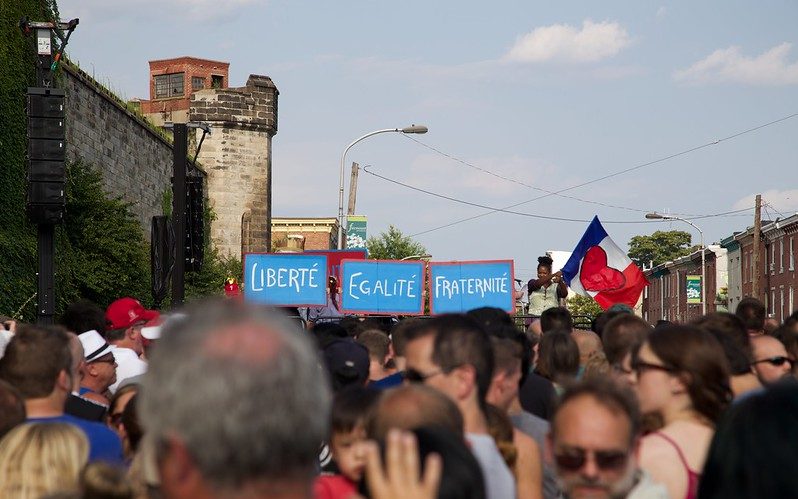
“Liberté, égalité, fraternité”, translated as liberty, equality, fraternity, is the national motto driving French society and culture. A motto that is chanted and written on signs during protests to transmit the notion of freedom, something that has built France and developed its pride. A motto with the goal of uniting a diverse country that holds diverse individuals under one roof. It conveys an image of France as a free county, where one can live in harmony with those different from them. Everyone is free and equal in the Republic. Well, everyone except for those who are Muslim.
Since 1905, France has promoted the notion of “laïcité”, the principle of a secular state with separation enacted between the Church and the State, “guaranteeing that all citizens regardless of their origin, race or religion are treated as equals before the law and respecting all religious beliefs”, as cited by the French Government website. Religion was removed from the public sphere, becoming a private practice between friends and family.
Despite religion being removed from state interest, there has been a growing attempt to control a particular religion that has faced widespread animosity in recent years: Muslims, who have the largest representation of all Europe in France, have seemed to be largely exempt from the so-called guaranteed equality promised by the French state. In the wake of the January 2015 Charlie Hebdo shooting and consecutive terrorist attacks, Islamic violence and discrimination have gradually intensified with states acting as the main perpetrator in formalising the intolerance vis-á-vis the Muslim population.
Traditional Muslim clothing, in being the most obvious symbol of religious practice, has been a particular target of State oppression. It was justified as a strategy to identify cases of radicalisation as well as a way to fight “oppression” suffered by Muslim women. Headscarves were banned in schools in 2004 and in 2010, France introduced the “Burqa Ban”, a law forbidding the wearing of face-covering veils or other masks in public spaces, including the niqab and hijab. Despite criticism, the law continues to be in place and is only intensifying Islamophobia and discrimination. In 2016, the Burkini, a modest swimsuit for Muslim women who wished to cover their bodies, was also banned.
This year, the French senate plans to further infringe on individual liberties by voting in favour of banning under-18s from wearing Islamic headwear. Mothers would also be prevented from wearing a hijab when accompanying their children to swimming pools and on school trips. According to Macron, his goal is to defend the rights of women and fight against oppression. Yet, the irony of his approach does not go unmissed, Muslim women are seen as oppressed and in need of saving by way of oppressive governmental measures that alleviate all choice they have;
A 2019 Ifop study found that 46% of Muslim women and 38% of Muslim men in France felt discriminated against due to their religion. Of the women who wore head coverings, 60% said they had been a target of discrimination whereas 44% of women without head coverings felt that they had also been discriminated against.
Macron fears heightening Islamist separatism wherein Muslims are retracting themselves more and more from French society and its values. Yet, the Centre for the Study of Conflict in Paris found that Muslim citizens are largely in line with the values of the state. In fact, the sole complaint they have is the systematic discrimination they suffer, particularly in the sectors of housing, employment, and the police. A 2020 Ipsos survey also found that 92% of Muslims were proud to be French.

Evidently, Islam is not part of religious history in France. However, when the state decided to become secular, arguments such as hijabs not being part of French culture and ideals can no longer be relied upon. The notion of secularism has a role to prevent the state from having religious influence, not from people exercising their beliefs in their private sphere. This duality of promoting the notions of equality and freedom in a country where one minority group is more and more discriminated against is simply not sustainable.
Researcher Marie-Anne Valfort states that anti-muslim discrimination acts as a catalyst in the radicalisation process, a fact that has even been recognised by Macron. While he has attempted to make a clear distinction between extremist and the everyday Muslim, the political discourse of secularism has manipulated the narrative, grouping the two like they are a homogenous group, feeding islamophobia and well as radical discourse, essentially making the efforts by the government counterproductive.
There is no perfect example of how a secular state should approach religious freedom. Jihadists groups have certainly caused devastation in France as well as around the world through terrorism. And yet, jihadist groups make up a very small minority of Muslims, who primarily target Muslims in the countries where we see massive groups fleeing war and conflict. As Muslim discrimination has been shown to feed this anti-European discourse by extremist groups, it is crucial to not lump together the innocent with the dangerous.
With private life and public life becoming more difficult to separate, women are finding themselves in positions where they are denied key aspects of their being. The government is having to respond to public fears about extremism while trying to respect the rights of Muslims as French citizens. It is a difficult balance to achieve and yet the key is in finding this right balance, that must be drawn between methods of prevention of extremism while also addressing the islamophobia that these measures can enact amongst the public. The government, in the pursuit of anti-terrorism, should take a firm stance against Islamophobia in its rhetoric to ensure that the principles of the Republique are universal for all its citizens.
Sources Aroney, N., (2020) “New research shows religious discrimination is on the rise around the world, including in Australia”, The Conversation. https://theconversation.com/new-research-shows-religious-discrimination-is-on-the-rise-around-the-world-including-in-australia-141789 Boutaud, A., (2019) “LA DISCRIMINATION À L’ÉGARD DES MUSULMANS EN QUELQUES CHIFFRES”, Ville Inclusive. https://ville-inclusive.millenaire3.com/billets/La-discrimination-a-l-egard-des-musulmans-en-quelques-chiffres Dodman, B., (2020) “‘Islam is being hyper-politicised in France, but Muslims are not part of the debate’”, France 24. https://www.france24.com/en/france/20201030-islam-is-being-hyper-politicised-in-france-but-muslims-are-not-in-the-debate Fracois, M., (2020) “France’s Treatment of Its Muslim Citizens Is the True Measure of Its Republican Values”, Time. https://time.com/5918657/frances-muslim-citizens-republican-values/ France Diplomacy, “Secularism and Religious Freedom”, Ministère de l’Europe et des Affaires Étrangères. https://www.diplomatie.gouv.fr/en/coming-to-france/france-facts/secularism-and-religious-freedom-in-france-63815/article/secularism-and-religious-freedom-in-france Gorce, B., (2020) “Racisme, préjugés, discriminations : les musulmans sont-ils plus victimes que les autres ?”, La Croix. https://www.la-croix.com/France/Racisme-prejuges-discriminations-musulmans-sont-ils-victimes-autres-2020-11-12-1201124260 Ipsos MORI, “A review of survey research on Muslims in Britain”. https://www.ipsos.com/sites/default/files/ct/publication/documents/2018-03/a-review-of-survey-research-on-muslims-in-great-britain-ipsos-mori_0.pdf The Cube, (2021) “#HandsOffMyHijab: Online criticism grows over proposed French law banning hijab for children, Euronews. https://www.euronews.com/2021/04/12/handsoffmyhijab-online-criticism-grows-over-proposed-french-law-banning-hijab-for-children The Economist, (2019) “Muslims living in the West are gradually becoming integrated”. https://www.economist.com/graphic-detail/2019/02/18/muslims-living-in-the-west-are-gradually-becoming-integrated McAuley, J., (2020) “France mandates masks to control the coronavirus. Burqas remain banned.”, The Washington Post. https://www.washingtonpost.com/world/europe/france-face-masks-coronavirus/2020/05/09/6fbd50fc-8ae6-11ea-80df-d24b35a568ae_story.html Mangion, C., (2016) “Bad Habits? France’s ‘Burkini ban’ in Historical Perspective”, History Workshop. https://www.historyworkshop.org.uk/bad-habits-frances-burkini-ban-in-historical-perspective/ Valfort, M., (2018) “Anti-Muslim Discrimination in France: Evidence from a Field Experiment. http://ftp.iza.org/dp11417.pdf Williamson, L, (2016) “What do liberty, equality, fraternity mean to France now?”, BBC News. https://www.bbc.com/news/world-europe-36775634




Be First to Comment