
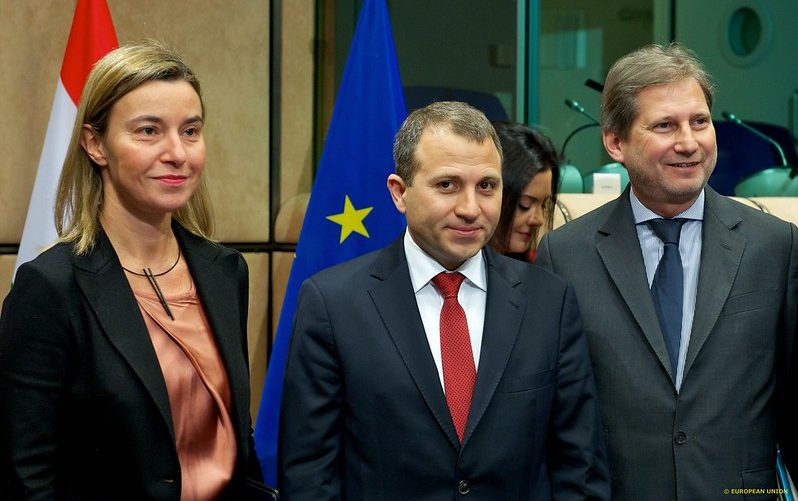
Three years ago in Paris, fifty countries conditioned $11 billion in aid on reform to tackle what is behind Lebanon’s collapse: poor governance. Reforms remain distant, and the EU’s plan to sanction elites is too little, too late in a time when Europe should aid Lebanon’s civil society. Targeted sanctions are sound in theory. States can punish specific individuals without hurting ordinary people with an embargo. Most of Lebanon’s elite have money in Europe and send their children to European universities, so it makes sense to target them with sanctions.
Though sound, in theory, targeted sanctions rarely bite. Historically, sanctions without an embargo have a low success rate of 25% (Hufbauer & Oegg, 2000). The French travel ban shows just how easy it is for the elite to escape through the net. Many in Lebanon’s elite are dual EU citizens and enter France through Italy. Given the record, targeted sanctions are more likely to satisfy the EU’s need to do something than achieve reforms.
Effect rather than effectiveness is another concern. Targeting specific leaders could break the balance between sectarian groups. Lebanese politics is already shaky. Prime Minister Saad Hariri resigned after President Aoun, an ally of Iranian-backed Hezbollah, rejected his’s final proposal of a cabinet of 24 neutral experts.
Lebanon’s new prime minister-designate, Najib Mikati, will likely form another government incapable of reform, so EU officials are correct to push on with sanctions. It shows solidarity with the Lebanese people in next year’s election. A show of solidarity is likely the most that sanctions can achieve, at least before the election. Most politicians fear punishment at the election if they act now, so they will unlikely form a government before May, regardless of how bad sanctions hurt them.
Lebanon needs a government. The World Bank believes the country’s economic collapse is among the top three most severe global crises in 150 years (The World Bank, 2021). The economy has fallen from $60 billion to $15 billion in just five years. Inflation has devalued the pound by 90% and pushed up prices since 2019 (Mroue, 2021). Food prices exploded by 400% in 2021, and the government recently hiked the prices of fuel and subsidised bread by 35% and 18%, respectively (The Arab Weekly, 2021; Mroue, 2021). The fallout is a humanitarian crisis: the perfect storm for another refugee crisis.
The poverty rate surged from 28% to 55% between 2019 and 2020, and the rate of poverty will reach 75% by the end of 2021 (Bisat, Cassard, & Diwan, 2021). The explosion in poverty has left many in hunger. Data from 2020 shows that almost one-quarter of Lebanese and 40% of Syrian households skip a meal daily because they cannot afford food (Hamadé, 2020).
The situation is likely worse today. The worry is that people will have to rely on political factions for food and security, as they did between 1975 and 1990 during the civil war.
You could accuse EU leaders of negligence were it not so hard to see what else the EU can do. The answer is certainly not more aid, at least not to the Lebanese State. As Human Rights Watch warns, “donors should not disburse emergency aid, including for housing, food, and health care, directly to the Lebanese government given its inability to secure these rights.”
Lebanon would win gold if embezzling aid was an Olympic sport. Officials quickly sold the 1675 kilograms of Ceylon tea (labelled not for sale) that Sri Lanka gifted after the Beirut blast (Uddin, 2020). Officials also gave UN grants for Lebanon’s e-government strategy to a marketing agency owned by the President’s daughter. Lebanon ranked 69/173 countries in 2004 when the UN made the grants and 127/193 by 2018 (Merhej & Ghreichi, 2021).
The European Parliament is also trying to recuperate millions in aid for a recycling plant after parliament found that eight composting drums were improperly installed and had poisoned the groundwater. Sanctions could raise the cost of corruption which would help the Lebanese State become a credible distributor of aid. However, this would take time, and Lebanon is quickly running out of time. The State is bankrupt to the point where it cannot guarantee the country’s security. The army relies on foreign donations. Soldier earned $800 a month before the crisis. Today, they make between $70-$90 a month (Vohra, 2021). Or roughly $2 per day.
A bailout may not be enough. The IMF would usually lend $5 billion to countries like Lebanon—far below the $28 billion in external funding that the Lebanese government needs. The World Bank, the European Investment Bank, and the European Bank for Reconstruction and Development would likely give $8 billion. So even if the IMF lends $10 billion, external funding will only reach $18 billion. These international organisations would also condition a bailout on reforms, just like aid. Reforms that sanctions are unlikely to deliver soon enough.
Perhaps then, the EU should lobby for humanitarian intervention. The dormant UN trusteeship council could administer Lebanon like it administered countries unable to exercise sovereignty in the past. There is a moral case for intervention. Under the UN doctrine, “responsibility to protect”, the world has a responsibility to intervene when a country is unable to exercise sovereignty. And Lebanon is hardly sovereign anymore.
It is hard to see how an intervention would work, though. There is no broker for a trusteeship council or even a new Taif Agreement. Germany has declared one of Lebanon’s most important actors, Hezbollah, a terrorist organisation. France has a colonial history with the country, and the countries of the Middle Eastern are too partisan.
Intervention is off the table, as is a bailout and more aid. Sanctions are also too little, too late. What then should the EU do? These options all share the same flaw: their focus is on institutions or individuals at the state level.
The solution is to focus on civil society, so the EU should combine sanctions with more aid to non-governmental organisations. A focus on civil society would mean that the EU could help Lebanon build a more resilient society without waiting for elites to change their behaviour.
Sources Bisat, A., Cassard, M., & Diwan, I. (2021, March 29). Lebanon’s economic crisis: A tragedy in the making. Retrieved from MEI: https://www.mei.edu/publications/lebanons-economic-crisis-tragedy-making Hamadé, K. (2020, November 13). Lebanon’s Food Insecurity and the Path Toward Agricultural Reform. Retrieved August 02, 2021, from Carnegie Middle East Center: https://carnegie-mec.org/2020/11/13/lebanon-s-food-insecurity-and-path-toward-agricultural-reform-pub-83224 Hufbauer, G. C., & Oegg, B. (2000, February 23). Targeted Sanctions: A Policy Alternative? Retrieved August 02, 2021, from Peterson Institute for International Economics: https://www.piie.com/commentary/speeches-papers/targeted-sanctions-policy-alternative Merhej, K., & Ghreichi, M.-C. (2021, March 11). Foreign Aid to Lebanon: Goodwill Marred by Smoke and Mirrors. Retrieved August 02, 2021, from The Tahrir Institute for Middle East Policy: https://timep.org/commentary/analysis/foreign-aid-to-lebanon-goodwill-marred-by-smoke-and-mirrors/ Mroue, B. (2021, June 29). Lebanon increases fuel prices by more than 35% amid crisis. Retrieved August 03, 2021, from AP News: https://apnews.com/article/middle-east-lebanon-prices-business-e98db42886f04fc2583d4de854d5fbe1 The Arab Weekly. (2021, April 17). Lebanese Hezbollah braces for state collapse. Retrieved August 02, 2021, from The Arab Weekly: https://thearabweekly.com/stockpiling-fuel-iran-lebanese-hezbollah-braces-state-collapse The World Bank. (2021, June 01). Lebanon Sinking into One of the Most Severe Global Crises Episodes, amidst Deliberate Inaction. Retrieved August 02, 2021, from The World Bank: https://www.worldbank.org/en/news/press-release/2021/05/01/lebanon-sinking-into-one-of-the-most-severe-global-crises-episodes Uddin, R. (2020, September 09). Beirut Explosion: Trouble brewing for Lebanon’s president after Sri Lankan tea gift. Retrieved from Middle East Eye: https://www.middleeasteye.net/news/beirut-explosion-lebanon-aoun-sri-lanka-tea-donation-guards Vohra, A. (2021, July 02). What would the collapse of Lebanon’s army mean? Retrieved 02 August 2021, from Aljazeera: https://www.aljazeera.com/news/2021/7/2/what-would-the-collapse-of-lebanons-army-mean

Be First to Comment