
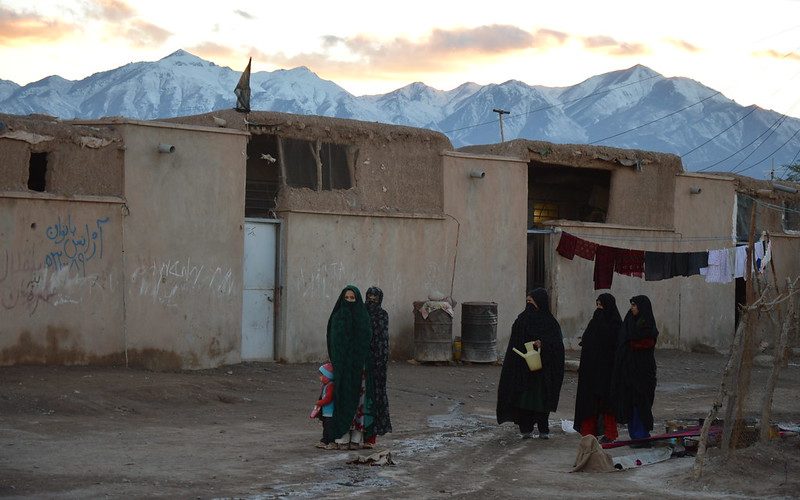
As the United States started to pull its troops out of Afghanistan, the Taliban forces saw an opening to start a large offensive1 deeper into the country, seemingly with the aim of achieving total control. This was not unexpected but what did take people by surprise was the speed and the level of organization by which the Taliban forces took over more and more provinces as well as the weakness of Afghan armed forces in attempts of stopping them. Many have raised legitimate questions whether all the time, money, and energy spent on training the Afghan forces in the past 15 years was worth it, but I will not examine the past. I’m more interested in the future of Afghanistan and what impact that future will have, if any, on Western Balkan states, particularly Bosnia and Herzegovina.
As a result of the Taliban takeover of Afghan provinces, more and more Afghan civilians become internally displaced as they flee their home villages towards the capital city of Kabul. In the case of the Taliban takeover of Kabul, which is a realistic scenario at this point, not only will we see a grave humanitarian situation as Taliban forces punish their political opponents, civil society leaders and women’s rights activists but also a new migration crisis which will inevitably be headed towards Europe.
If that happens, Afghan civilians will permanently be stuck in the Western Balkans, considering the fact that European Union closed its borders in Croatia for illegal migrants coming from the MENA region. As a consequence, the most burden of the illegal migration crisis has been carried by Bosnia and Herzegovina whose dysfunctional internal state system prevents it from placing adequate policies in place to deal with the migration crisis. For example, illegal migrants are not equally distributed across the territory of Bosnia and Herzegovina2 due to the fact that every Canton has the right to decline to open up migrant centers and shelters in their territory. Additionally, Bosnia and Herzegovina does not have an updated Migration and Asylum strategy that would serve as a guiding star in dealing with the crisis.
Consequently, only Sarajevo Canton and Una-Sana Canton (which borders Croatia), which are Bosniak-dominated Cantons, took in large quantities of illegal migrants and are barely keeping control of it. If Afghan refugees do start moving towards Europe en masse, they will inevitably end up stuck in Bosnia and Herzegovina, a country that cannot protect their basic human rights. For this reason, it is imperative that all government levels of BiH start preparing and adapting policies in place for possible future events as well as to coordinate with other Western Balkans states in order to have a unified response to the future crisis.
I truly do not understand the reasoning of the Biden administration. The “They have to take responsibility for their own country” argument3 from President Biden is legitimate but you cannot expect to have an organized national response from a country in which the United States still has not finished the process of nation-building, not to mention that the sudden retreat of US forces demoralizes Afghan forces on the ground which are left without appropriate air support. I also understand the “end forever wars” argument but the United States cannot ignore terrorist thugs undoing 20 years of progress in the field of women’s rights and civil society. The international community cannot ignore the fact that if Kabul falls into the hands of the Taliban, Afghanistan will become a safe haven for terror organizations that may plan the next 9/11.
Also, by pulling out your forces, you are handing over the country to the influence of Russia and China who already have started negotiating with the Taliban, giving them legitimacy. If the United States is serious about great power competition, it will not give up on Afghanistan and not allow Russia and China to gain influence across South/Central Asia. Yes, mistakes were made in the past but instead of leaving, the US should stay and do better. Fight for the democratic principles they preach and for a better future for Afghanistan. Because a safe and stable Afghanistan means a safer US homeland as well as a safer Europe.
Sources Ansari, T., Rust, M., & Mollica, A. (2021, August 13). How the Taliban Takeover of Afghanistan’s Provincial Capitals Is Unfolding. WSJ. https://www.wsj.com/articles/how-the-taliban-takeover-of-afghanistans-provincial-capitals-is-unfolding-11628890519 Monella, L. M. (2021, January 20). What are the real reasons behind Bosnia’s migrant crisis? Euronews. https://www.euronews.com/2021/01/19/what-are-the-real-reasons-behind-bosnia-s-migrant-crisis-bihac Toosi, N., McLeary, P., & Ward, A. (2021, August 12). Biden on Afghanistan: Not my problem. POLITICO. https://www.politico.com/news/2021/08/11/biden-afghanistan-not-my-problem-503928
- Ansari, T., Rust, M., & Mollica, A. (2021, August 13). How the Taliban Takeover of Afghanistan’s Provincial Capitals Is Unfolding. WSJ. https://www.wsj.com/articles/how-the-taliban-takeover-of-afghanistans-provincial-capitals-is-unfolding-11628890519 [↩]
- Monella, L. M. (2021, January 20). What are the real reasons behind Bosnia’s migrant crisis? Euronews. https://www.euronews.com/2021/01/19/what-are-the-real-reasons-behind-bosnia-s-migrant-crisis-bihac [↩]
- Toosi, N., McLeary, P., & Ward, A. (2021, August 12). Biden on Afghanistan: Not my problem. POLITICO. https://www.politico.com/news/2021/08/11/biden-afghanistan-not-my-problem-503928 [↩]




Be First to Comment