
For weeks, we have watched with concern the battle of Trump and his supporters, trying to overturn the election result of November 3, 2020, in which Joe Biden came forward as elected president and Kamala Harris as vice-president.
Since Joe Biden’s win of the presidency, Trump and members of his team brought out statements of alleged voter fraud on a daily basis, and countless lawsuits were filed based on unfounded arguments of electoral fraud in an attempt to overturn the election. Thankfully, none of these lawsuits brought any change in the electoral outcome. Yet, Trump and his team continued with the consistent undermining of the outcome of this democratic election, made baseless claims of “voter fraud”, and called it a “stolen” election. Thereby, they managed to mobilize a vast number of Trump supporters who helped disseminate these false allegations. In the end, an already divided American society faced even more division.
America’s long-praised democracy, which had been under increased pressure over the past four years under President Trump, had been seriously threatened amidst these developments. And frankly, a president that refuses to concede after a lost election and continuously makes false claims about voter fraud is just that: a threat to democracy itself.
The January 6 Coup Attempt
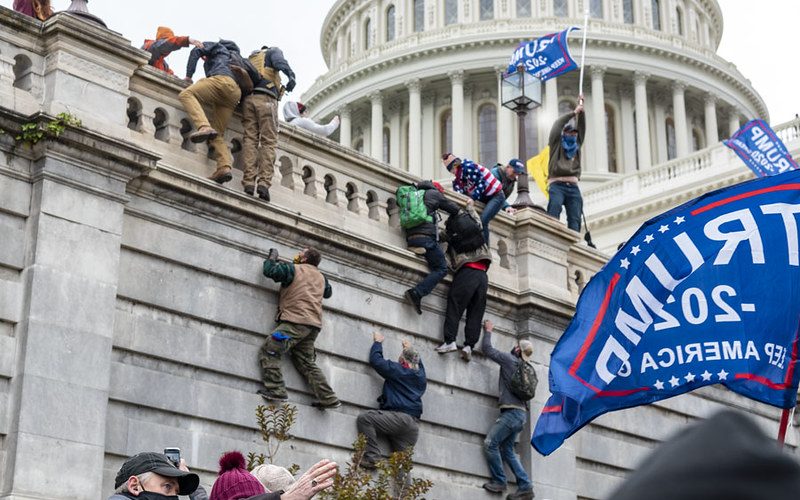
Trumpism and Trump supporters’ fight against this alleged “stolen election” had its climax on January 6, the day Biden’s election as next US president and the electoral votes were supposed to be confirmed in Congress. Already days before the set confirmation in Congress, pro-Trumpers announced their planned protests on January 6 in Washington DC, calling for violence and a revolution.
Trump, in a speech on January 6, further incited his supporters, openly calling on them to “walk down to the Capitol” and insisting that they “are going to have to fight much harder.”
Not much later, Trump protesters marched down to the Capitol, where lawmakers were supposed to certify Biden’s win. Due to the initial small Capitol Police presence, the supporters were able to break into the building, disrupting the voting process as officials had to be evacuated or barricaded in order to be safe. Trump first refused to mobilize the National Guard. It required intervention from other officials for him to agree to deploy the National Guard and secure the Capitol. It took hours until the police and the National Guard finally managed to take back control of the Capitol, evicted all unlawfully present people, and the voting process could resume.
Moreover, it took a long time and a lot of convincing until President Trump finally put out a statement, asking his supporters to “remain peaceful”. In his short video statement that was later removed from Twitter and Facebook, he asked the pro-Trump supporters to go home now. Yet, in that same message, he also once again denounced the outcome of the election, thereby only adding fuel to the fire. He also told his supporters who rampaged in the Capitol that they were “very special” and “we love you”. It took him more than 24 hours to finally condemn the attack and the violence of the day before.
White Supremacy and right-wing extremism as domestic terrorism
Some might think this goes too far, but let us call these people who stormed the Capitol and tried to overturn a democratic election precisely what they are: domestic terrorists.
These people came with the intent to instil fear, exert pressure, destroy and spread chaos. They were not peaceful protesters and never have been. They were aggressive, right-wing extremists – contrary to some Trump supporters’ claim that these protestors were from Antifa, dressed up as Trump supporters. (The fact that Trump’s supporters all of a sudden accuse Antifa activists, and some even seem to believe this falsehood is beyond me.)
Even worse, the soon-to-be Ex-President, who incited these people and motivated them to go to Congress and wreak havoc, watched safely from the White House as the chaos unfolded. He waited long enough to call on the National Guard to take control of the situation.
At this point, one needs to remember the Black Lives Matter protests in the summer of 2020, during which the National Guard was from the beginning present in huge numbers and ready to defend the Capitol. Back then, protestors were met with tear gas and violence, some even arrested. The difference in the treatment of protestors from the left contrary to those from the right is utter hypocrisy at best and a prime example of America’s tolerance of white supremacy and right-wing extremism.
In addition, let us imagine the violence these people that invaded the Capitol would have encountered if they were people of colour. It is safe to assume that more people would have been shot and killed and that the police’s overall conduct would have been more assertive, aggressive and violent. Had they been Muslims, they would have been called terrorists immediately.
But these extremist intruders were majority white, so what shall we call them? Just a bunch of “mentally ill” protestors? No. These people are domestic terrorists, so let us call them exactly that. They serve as a textbook example for right-wing extremists’ propensity to use violence to get their way and for the danger this group of people can pose to society and the democracy of a nation.
The threat to (American) democracy
American democracy is under threat, and frankly, it has been during the past four years. Time and again, Trump undermined basic democratic principles, disregarded the constitution and acted out like a child that simply wants to get their way.
The most recent and perhaps even most dangerous threat to democracy was his unwillingness to concede to Joe Biden after the presidential election. His baseless claims of a fraudulent and “stolen” election and his countless lawsuits have changed nothing about the outcome of the election but further stirred unrest and divided the society.
Trump’s false allegations about a stolen election have also instilled further mistrust about democratic processes in pro-Trumpers, spurred on conspiracy theories, above all QAnon, and encouraged people to disregard the democratic outcome of an election.
Yet, Trump’s behaviour is not only dangerous for American democracy. America has often been named as an aspirational example for other democracies. Watching this type of behaviour from afar gives false impressions of what a democracy should look like, and America is setting the bar for democracies pretty low at the moment. If others perceive that what the American president is doing with American democracy as aspirational and “normal” for a democracy, namely, to trample on and disregard any democratic principles, then let us not be surprised if flawed democracies or quasi-autocracies flourish, as they have done so in the past years.
Beacon of Hope
In light of the January 6 events, the outlook for American democracy remains dark. However, there is a reason for hope.
First, big social media platforms, above all Facebook and Twitter, finally suspended Trump’s accounts, along with the accounts of further QAnon conspiracy theorist spreaders. In addition, Parler, a social network preferably used by right-wing extremists that gained popularity, especially after Trump had been banned from other social media networks, has been shut down. The app has been banned from Apple App Store and Google Play Store, and Amazon removed Parler from its cloud hosting service. These are significant steps, as they help curb the spread of baseless conspiracy theories and the online incitement of violence, even though some falsely compare these actions to censorship.
Secondly, Biden was, after the Capitol was cleared and lawmakers were able to resume the vote, confirmed by Congress as the winner of the election. This goes to show that, despite Trump’s rhetorical and legal attacks, the result of the democratic process was acknowledged.
Lastly, the House stated that if vice-president Pence refuses to enact the 25th amendment, which would strip Trump of his power in his last days as president, they will move to impeach Trump on the grounds of incitement. As Pence did not enact the 25th amendment, the House moved forward with impeaching Trump “for inciting a violent insurrection against the US government”. The vote to impeach Trump was 232 to 197, with 10 Republicans joining the Democrats. The impeachment could ban Trump from running for public office, thereby preventing him from running in 2024.
All these developments are promising and necessary to restore faith in American democracy and send a strong signal that democracy and democratic decisions must be respected.
In the end, will the incoming president be able to unite the divided society? And will social media platforms be able to deal with the increasing spread of fake news, hate speech and conspiracy theories that endanger democracy? Only time will tell.
Sources
Brettschneider, C. (2021): We must impeach Trump and bar him from holding office again. Now, The Guardian, https://www.theguardian.com/commentisfree/2021/jan/07/we-must-impeach-trump-and-bar-him-from-holding-office-again-now, accessed 12.01.2021
Chavez, N. (2021): Rioters breached US Capitol security on Wednesday. This was the police response when it was Black protesters on DC streets last year, CNN, https://edition.cnn.com/2021/01/07/us/police-response-black-lives-matter-protest-us-capitol/index.html, accessed 07.01.2021
Davis, C. (2021): Trump supporters falsely claim a far-right activist at the US Capitol is actually a member of ‘Antifa’, Businessinsider, https://www.businessinsider.com/trump-supporters-falsely-claim-a-far-right-activist-at-the-us-capitol-is-actually-a-liberal-2021-1?r=DE&IR=T, accessed 07.01.2021
Fandos, N. (2021): House Sets Impeachment Vote to Charge Trump With Incitement, The New York Times, https://www.nytimes.com/2021/01/11/us/politics/house-trump-impeachment-vote.html, accessed 12.01.2021
Fung, B. (2021): Parler has now been booted by Amazon, Apple and Google, CNN, https://edition.cnn.com/2021/01/09/tech/parler-suspended-apple-app-store/index.html, accessed 12.01.2021
Haberman, M. (2021): Trump Told Crowd ‘You Will Never Take Back Our Country With Weakness’, The New York Times, https://www.nytimes.com/2021/01/06/us/politics/trump-speech-capitol.html, accessed 07.01.2021
Mascaro, L. et al. (2021): Biden win confirmed after pro-Trump mob storms US Capitol, APNews, https://apnews.com/article/joe-biden-confirmed-0409d7d753461377ff2c5bb91ac4050c, accessed 12.01.2021
Pitofsky , M.(2021): 70K QAnon Twitter accounts suspended in the wake of Capitol riot, The Hill, https://thehill.com/policy/technology/533756-70k-qanon-twitter-accounts-suspended-in-the-wake-of-capitol-riot, accessed 12.01.2021
Walsh, J. (2021): Reports: Trump Resisted Sending National Guard To Quell Violent Mob At U.S. Capitol, Forbes, https://www.forbes.com/sites/joewalsh/2021/01/06/reports-trump-resisted-sending-national-guard-to-quell-violent-mob-at-us-capitol/?sh=5e40d2b41e18, accessed 12.01.2021
Weiland, N. (2021): Impeachment Briefing: Trump Is Impeached, Again, The New York Times, https://www.nytimes.com/2021/01/13/us/politics/impeachment-briefing-trump-is-impeached-again.html?searchResultPosition=4, accessed 17.01.2021
Wise, A. (2021): Trump Condemns Capitol Hill Violence, Ignores His Role In Inciting The Mob, NPR, https://www.npr.org/sections/congress-electoral-college-tally-live-updates/2021/01/07/954587997/white-house-condemns-violence-on-capitol-hill-without-addressing-trumps-role?t=1610431917515, accessed 12.01.2021
Zuidijk, D. & Mehrotra, K. (2021): Trump Supporter Rage Simmered on Social Media Before D.C. Violence, Bloomberg, https://www.bloomberg.com/news/articles/2021-01-07/trump-supporter-rage-simmered-on-social-media-before-dc-violence, accessed 07.01.2021





Be First to Comment