
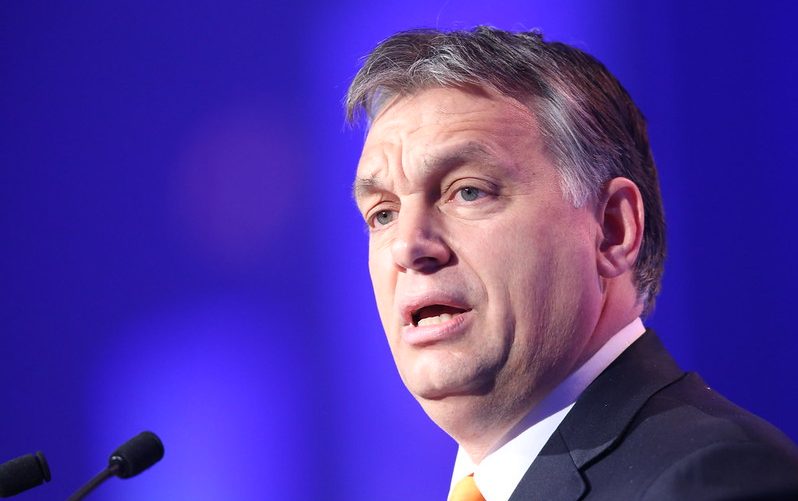
It did not come as a surprise to most when it was announced in the late evening hours of April 3rd that Hungarian prime minister Viktor Orbán once again prevailed in the 2022 parliamentary elections, winning his fourth consecutive term. The united opposition which, some hoped, would finally remove Orbán from power, did not succeed in doing so.
However, what turned out to be surprising to some was the Fidesz party’s landslide victory, winning a two-thirds majority for yet another four-year term and even increasing their number of seats in parliament from 133 to 135. “Our win is so huge you can see it from the Moon, never mind from Brussels,” Orbán boasted, indicating a tough four years to come in Hungary’s conflict-ridden relationship with the European Union.
After weeks of polls indicating a neck-and-neck race between Orbán’s opponent from the united opposition movement, Peter Márki-Zay, and himself, people wonder how Fidesz could secure such a clear victory. There are several explanations for it.
In his past 12 years in power, Orbán created a system that makes it hard, if not almost impossible, to get rid of him through a democratic election. As reported by the Financial Times, previous elections that were observed by OSCE missions were already declared “free but not fair” due to the “dominant presence of Fidesz in the media and advertising spaces and because of a heavily gerrymandered voting system.” This election was no different.
Independent media is almost non-existent in Hungary due to regulations set in place by the Fidesz party, the media watchdog KESMA that was created in 2018, and newspaper outlets that were forced to close down. The government assaulted the judiciary multiple times over the years and introduced laws that are threatening the independence of Hungary’s judiciary. Most importantly, the governing party redrew electoral districts, a process known as gerrymandering, which puts them at an advantage in every single election.
These realities make it hard for any opposition candidate to win an election in Hungary, never mind appeal the election result. And even if there were a new government to come to power, it would be extremely difficult to act: the Fidesz government made sure over the past years to cement its power in virtually all important institutions, companies, NGOs, and the media by installing Fidesz loyalist at the top of all of these.
Apart from these clear advantages for Fidesz, there are new geopolitical realities that have presumably put Orbán at an advantage in this particular election. In particular, the Russian invasion of Ukraine likely helped him to secure this fifth electoral victory in his entire political career. He portrayed himself as the defender of the Hungarian nation and interests by arguing that he wants to “keep Hungary out of this war” and keep the gas prices low for the Hungarian population. He also falsely argued that the opposition wants to drag Hungary into this war, which many voters probably believed, given the distorted media landscape and the overwhelming amount of pro-Fidesz propaganda. Moreover, Orbán found a new opponent to portray as an enemy from which Orbán will defend Hungary, next to Soros, the liberal international left and others: Ukrainian president Volodymyr Zelensky.
That leaves us with the question of what to expect in the coming four years of Orbán’s rule.
First, there will likely be a further de-democratisation of the country. Having transformed the country into an electoral autocracy over his past 12 years in power, Orbán is unlikely to stop there. He will find new, “innovative” ways to ensure that his party loyalists control the country and all its crucial institutions, while also making sure that he will stay in power for as long as possible.
Secondly, Brussels should brace itself for a bumpy ride when it comes to its relations with Hungary. Even though the EU has known for some time that cannot rely on Hungary, in particular when it comes to defending European values and democracy, this feeling is now once again reinforced. The Russian invasion of Ukraine has shown once again that Orbán is unapologetically pro-Putin and the Trojan Horse in the EU and, therefore, an unreliable partner for the EU.
In addition, shortly after the election, the EU Commission did not hesitate to announce that it would trigger the conditionality mechanism that links EU funds to respect for the rule of law and could cut Orbán off from receiving these funds. This gives Orbán another opportunity to portray the EU as Hungary’s enemy and pretend that the country is being “attacked” by it, an argument which he will once again use to his advantage.
Finally, it will continue to be difficult for the EU to make Hungary support its course and European unity, particularly in times like these when it is more important than ever. Under Orbán, the country is a threat to the European project, and both, the EU and Hungary, will have to keep on balancing out their differences and diverging interests. However, its price will likely be sacrificing democracy and paving the way for further solidifying Fidesz’s all-encompassing power – and thereby leading to Hungary’s continued autocratisation.
Sources Adler, K. (2022): Victory for Hungary’s Orban means a headache for the EU, BBC, https://www.bbc.com/news/world-europe-60978909 Bede, M. (2022): One Hungarian media monster to rule them all, International Press Institute, https://ipi.media/one-hungarian-media-monster-to-rule-them-all/ Dunai, M. (2022): Orban’s bid for fourth straight term comes down to knife-edge vote, Financial Times, https://www.ft.com/content/f408cfa1-49b3-4a16-a465-95bfda439821 Gall, J. (2018): Hungary’s Latest Assault on the Judiciary, Human Rights Watch, https://www.hrw.org/news/2018/12/14/hungarys-latest-assault-judiciary Heil, A. (2022): Six Takeaways From Fidesz And Orban’s Big Hungarian Election Win, Radio Free Europe Radio Liberty, https://www.rferl.org/a/hungary-landslide-orban-takeaways/31785726.html Makszimov, V. (2022): Commission to trigger mechanism that could see Hungary lose EU funds, Euractiv, https://www.euractiv.com/section/politics/news/commission-to-trigger-mechanism-that-could-see-hungary-lose-eu-funds/ Szabolcs, D. (2022): Viktor Orbán’s fourth two-thirds majority, a disaster for the opposition coalition – key election results, Telex, https://telex.hu/english/2022/04/04/viktor-orbans-fourth-two-thirds-majority-a-disaster-for-the-opposition-coalition-key-election-results Tait, R. (2022): ‘We shouldn’t get involved’: Ukraine a key issue as Hungary heads to polls, The Guardian, https://www.theguardian.com/world/2022/apr/01/hungary-election-ukraine-a-key-issue-viktor-orban The Economist (2022): Viktor Orban’s victory is a triumph for illiberal nationalism, The Economist, https://www.economist.com/europe/viktor-orbans-victory-is-a-triumph-for-illiberal-nationalism/21808575





Be First to Comment