
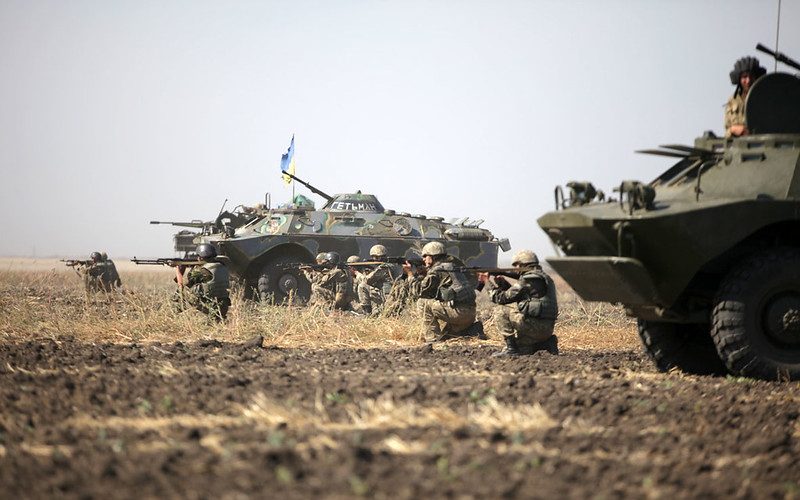
Talking about the ethics of war over Ukraine seems abstract and naïve in light of Donbas and its abandoned villages. It seems pointless to think about just war in a world of suffering where war is just war. Yet, it is because the suffering of war is real that we should think and talk about the ethics of war. Only when we talk can we take a stance, constrain violence, and hold military leaders accountable.
The language of just war helps us hold politicians and military leaders accountable. Yes, it is often abused by politicians, but remember that those who protested the Vietnam War unknowingly used the language of just war and their protests ended the war. Likewise, the principles that leaders say motivate them also commits them to behave accordingly or else face a crisis of legitimacy as the American leadership found out when people realised that Saddam had no weapons of mass destruction. In using the language of just war we consolidate standards against which leaders are judged if they fall short.
It is debatable if these standards are still meaningful. Modern warfare has deprived justice of its archaic meaning. Just killing is an excellent example of a standard that is meaningless in modern warfare. In just killing we hold our leaders to account based on the cause given for the killing rather than the killing itself. As a result, “Armageddon is justified if our hearts are pure.” 1It makes no sense to talk about a just nuclear war let alone victory when the outcome is mutually assured destruction. Nor does it seem right or meaningful to talk about justice even in a conventional war.
War is horrible regardless of how justified it is. When we talk about justice and war in the same breath, we ignore the tragedy of war. “Just war is just war”, and by ignoring this fact of war we often feel pious when we justify or condemn a war. ‘The war in Iraq was wrong’, people say righteously. Would they say the same thing if they knew what Saddam did in the years prior to the Iraq War? Saddam was evil. He waged a war on Iran that killed one million men; he invaded Kuwait; and he used chemical weapons to murder thousands of Kurds. The more conscious we are of a conflict’s historical context the less readily we pass moral judgments. Even just wars are just wars.
The adage that ‘just war’ is just war is ironically why we should think and talk about war. Critics are right to say that ‘justice discounts war’s tragic nature’, but they forget that the suffering of war is what makes judgment so important. History and context are crucial, but they should not distract from the need to make a judgment. Debating the ethics of war is about discovering where one stands on an issue. As such, the language of just war is a moral map to a non-ideal world and not an algorithm or a checklist that only serves power.
It is true that these critical reflections are often ivory-tower debates. Only Doctor Strangelove and your average academic would seriously consider whether mustard gas is more humane than anthrax. Though just war enables us to justify extreme measures, our scepticism to these ivory-tower debates is itself a critical reflection of how extreme measures are wrong.

In the same way, thinking about just war is a constraint rather than a forerunner to violence. Reflecting on the ethics of war places tense and complex demands on individuals2. Moral judgments are a burden that constrains us. When we discuss the ethics of using mustard gas, we place ourselves in a soldier’s shoes and imagine what it is like to be gassed. For a moment, we become Wilfred Owen’s soldier who says, “dim through the misty panes and thick green light, as under a green sea, I saw him drowning”. The thought constrains us. Similarly, we never discuss Hiroshima with pride because the moral burden constraints and forces us to recognise that Hiroshima was a wise choice rather than the right choice3. Thinking about the justice of war makes us sensitive to dirty hands and constrains us.
Thinking about just war is more than a moral map to an imperfect world. It is a set of principles that constrains us and helps us take a balanced stance. It is also a common language that we can use to hold politicians and military leaders accountable. Considering all of this, it would be naïve not to talk about the ethics of war.
Sources Cian, O’Driscoll, “Why Don’t You Tell Us About Them Rabbits, George? The Tragedy of Just War.” International Studies Review 15 (2013): 229-42. Donald, Wells. “How Much Can “The Just War” Justify?”. The Journal of Philosophy 66, no. 33 (1969): 819-29. Michael, Walzer. Just and Unjust Wars. 4 ed. New York: Basic Books, 2006.
Footnotes
- Donald, Wells. “How Much Can “The Just War” Justify?”. The Journal of Philosophy 66, no. 33 (1969): 819-29. [>]
- Cian, O’Driscoll, “Why Don’t You Tell Us About Them Rabbits, George? The Tragedy of Just War.” International Studies Review 15 (2013): 234 [>]
- Michael, Walzer. Just and Unjust Wars. 4 ed. New York: Basic Books, 2006, p.268 [>]





Be First to Comment