
Brief Overview
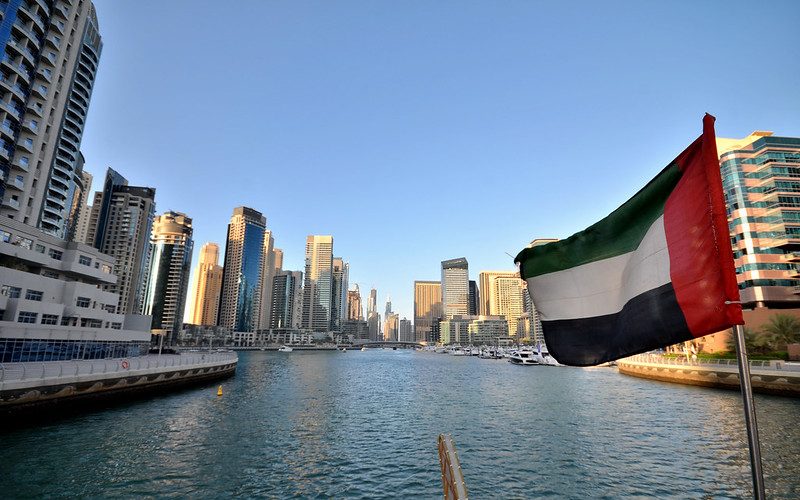
In ancient times and during the Islamic period, the economy was mainly based on the pearls and spices trade. Especially Dubai, a town initially of fishermen, has always been a place where trade and the meeting of people were normal. In addition, the ruling house Al Maktoum had managed to pacify and stabilize the area, making trade safer.
The real revolution, however, took place in 1958, when oil was discovered near Abu Dhabi. After that, new work began on widening the Creek and expanding the city, which brought new wealth and prosperity. On 2 December 1971, the seven emirs of the seven cities present in the Persian Gulf, together with the British, signed the treaty of independence.
The United Arab Emirates (UAE) has a population of 9 million people, 9/10 of whom are foreigners. Overall, 200 nationalities make up the population of the UAE, with an overwhelming presence of Indian and Pakistani expatriates, followed by Asian, African, European, and American populations. Hence, the UAE is basically a multi-ethnic and multi-cultural society, governed by the typical laws and customs of the Muslim religion.
The UAE is the sixth country in the world for oil production, but the trend is changing because, as elaborated below, the far-sighted choices of the Emirates government aim at reconverting all oil production into an economy based on green energy and technological innovation.
Most of the wealth is concentrated in the hands of a few Emiratis and Anglo-American monopolies.
Finally, historically the economy has always been based on import, export, and re-export.
GDP growth has seen rates of 3 to 4 % since 2012. Moreover, one AED (Dirham) would be equivalent to 0.22 euro, so the exchange rate of 4.30 is very favorable, not to mention that there are no taxes on the movement of capital with an interest rate on deposit of 2%.
Government planning
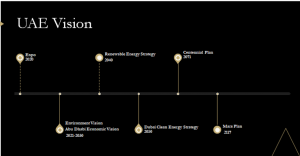
As already stated, most future investments are aimed at converting the oil economy to a sustainable economy, based on green and renewable energy and technological innovation. Astonishing, by 2117 the UAE wants to found a colony on the Red Planet, Mars, and they are currently among the first, together with United States, Russia, China, and ESA to have sent a probe.
To name a few interim milestones, by 2030 they want to finish the “Mohammed bin Rashid Al Maktoum Solar Park which will be the largest single-site solar park in the world, based on the independent power producer (IPP) model. […] Within 2050 with the Dubai Clean Energy Strategy, Dubai aims to produce 75% of its energy requirements from clean sources by 2050” (https://u. ae/#/).
Post-Covid future
According to recent estimates, the UAE will be the country with the highest Post-Covid growth rate, and among the first countries in the world able to attract investments in the following sectors: Technology Projects, Startups, Medical, Research and Development, Education.
The UAE is a dynamic hub for innovation, a recognized model of excellence throughout the Middle East and Africa that attracts capital and talent. In every Emirate, there are several Incubators and Accelerators, some dedicated to technology sectors and applications in the field of Artificial Intelligence (AI).
The long-term goal, however, is to become a hub of ideas and people.
Finally, EXPO 2020, postponed to October 2021, will be the turning point for the whole world, because it represents the opportunity for a global economic recovery and will generate value for billions of dollars, even if the real added value will never be objects and things, but the people, and above all, ideas. As a matter of fact, the official motto of EXPO is “Connecting Minds, Creating the Future”.
Sources Italian Chamber of Commerce in the UAE: https://iicuae.com/2021/02/09/hope-probe-reaches-mars-today/?lang=en UAE Government Website: https://u.ae/#/ IDM Sudtirol Power Point: https://www.idm-suedtirol.com/media/9bf9a3c7-4bdd-4ad9-b5b4-b3d843c97c3d/praesentation-vae.pdf
Be First to Comment