
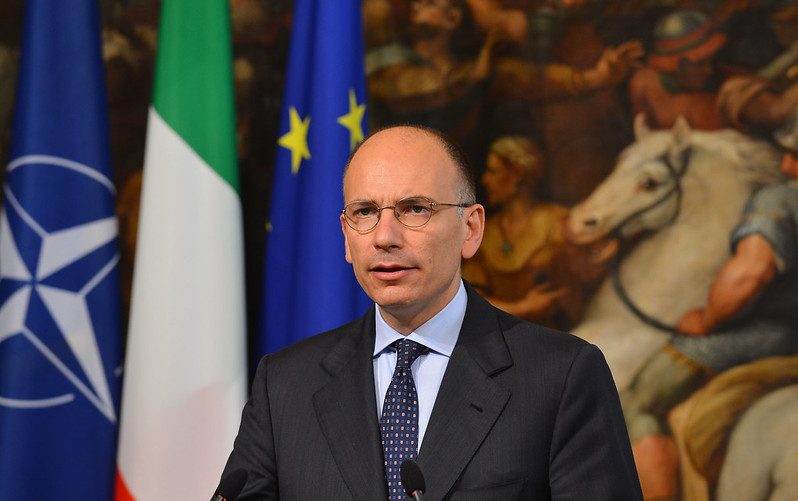
Recently, Nicola Zingaretti has resigned as secretary of the Italian Democratic Party. Established in 2007, this party unified two political fields: the former communists/socialists and the catholic social democrats. Since then, the Party had a central role in Italian politics, in particular in the last year when it supported the Governments during the pandemic, besides the Five Star Movement, Liberi e Uguali (a left-wing party), and Italia Viva (Matteo Renzi’s party). Zingaretti’s resignation was unexpected and created a crisis, that was overcome through the election of the former PM Enrico Letta as the new secretary. Before his election, Letta gave a long speech addressing various issues. His main goal appears to reform the Party for new future challenges. However, most experts think that the different souls of the party could consume Letta’s leadership, because they do not want a real change inside the party.
Allies and enemies
In Letta’s long speech, there is no reference to Liberi e Uguali (the far left). It is a minority group, but it is also the most left-wing political component in the parliament. The choice not to mention them could be a precise choice to distance the Democratic Party from positions too far from its new more moderate vision. The main opponents are, however, Salvini, Meloni and their creeping Euroscepticism. No mention of Forza Italia (Berlusconi’s party) either, seen probably as another moderate political force and a possible ally in the medium-term. As for the Five Star Movement, Letta is very far from Zingaretti’s idea. In his words, the Movement is only one of the many forces for dialogue but is no longer the essential component of a leftist coalition. In other words, Enrico Letta wanted to affirm a discontinuity with the past, opening up to the confrontation with the Movement, as long as it proves to be compatible with the liberal progressive approach that the new secretary will promote. From this point of view, Giuseppe Conte, former PM and now the new leader of the 5SM, is the one who could (and should) eliminate the last internal resistance and make the Movement an “establishment party”.
Internal strategy and external projection
At least in Letta’s words, the Democratic Party cannot survive only by holding public roles. It must return to the suburbs and small towns. It must overcome internal differences and open up to society, young people and syndicates, proposing an authoritative leadership based on the debate and not on mere charisma. In this sense, the involvement of party clubs and youth associations, with the help of new technologies, would be fundamental. Regarding economic policy, Letta wants more cooperation with syndicates, more attention to small and medium-sized enterprises’ needs. At last, he wants to promote forms of popular shareholding in large corporations with the direct involvement of their workers.

Italy and Europe
The crisis of national parties is a symptom, in Letta’s storytelling, of a generalized malaise within Italian democracy, whose main problem is not only the institutional framework but also the absence of parliamentary debate. In Letta’s view, deputies and senators too often abuse their constitutional rights to pursue individual goals instead of the common good. Perhaps also for academic and professional training, Letta wants to move the political debate in Europe to consolidate interstate solidarity and to overcome the imbalances in the Eurozone (first of all the presence of tax havens). Only in this way, the EU could act in the geopolitical chessboard without suffering the North-American and Chinese strategies.
Conclusion
The Democratic Party will create a ruling class “progressive in values, reformist in method, radical in political action”. It will remain pro-EU and pro-USA, whit an open mindset to confrontation and debate. However, it will not be a left-wing party, not even in intentions. The Democratic Party will be liberal and social democratic; it will support Draghi’s government and will use that position to relaunch its role as a moderate force in the next elections. The goal is most likely to take voters from the right, keeping a distance from far-left ideas and consolidating the consensus among the liberals, cultivating an alliance with the new Five Star Movement on specific issues (primarily environmental ones).
Sources Italian ex-prime minister Enrico Letta elected to lead Democratic party – The Guardian [online]: https://www.theguardian.com/world/2021/mar/14/italian-ex-prime-minister-enrico-letta-elected-to-lead-democratic-party Former Italian PM Letta takes helm of fractious Democrats – Reuters [online]: https://www.msn.com/en-us/news/world/former-italian-pm-letta-takes-helm-of-fractious-democrats/ar-BB1ezIft Italy’s ex-PM Enrico Letta returns to lead Democratic Party – Politico [online]: https://www.politico.eu/article/enrico-letta-italy-former-prime-minister-democratic-party-leader/ Enrico Letta’s speech at the National Assembly of the Democratic Party [online]: https://www.youtube.com/watch?v=VLxqucg5GwA&ab_channel=PartitoDemocratico Italy’s centre-left chooses ex-premier Letta as new leader – Financial Times [online]: https://www.ft.com/content/2d498d4c-63fa-4613-a66f-01049a25a0e6




Be First to Comment