

The Rule of Law Conditionality Mechanism’s background
Over the past years, the European Union (EU) faced a serious rule of law crisis in some of its member states, most notably Hungary and Poland, along with the misappropriation of EU funds in said countries, which gave reason for concern. Finally, in 2020, it seemed as if the EU found a way to prevent further breaches of the rule of law in its member states, introducing a tool called the “Rule of Law Conditionality Mechanism”. With this mechanism, European institutions should be able to “withhold funds from a Member State, should breaches of the rule of law in said Member State ‘sufficiently directly’ affect the EU’s budget or its financial interests“.
However, achieving the adoption of the mechanism presented itself as difficult: Hungary and Poland, given the significance of EU funds to their economies and the likelihood of being cut off from funds due to their disregard for the rule of law, intended to block the adoption of the Commission’s proposal for the mechanism. The two countries’ prime ministers attempted to water down the terms of the conditionality tool, as well as alter its application. Then, the Union’s legislative body continued working on the proposal according to “the framework set out by the European Council” and finally an agreement was reached that paved the way for the adoption of the conditionality mechanism in the European Council. However, unhappy with the final result, Hungary and Poland yet again threatened to veto the mechanism. Further wrangling followed and “The Council presidency and the Commission president then engaged with the two recalcitrant governments behind closed doors, and cobbled together a deal that was subsequently submitted to, and endorsed by, the European Council and the Commission, respectively.”
In a compromise between the Council presidency, the Commission president and the two countries, it was agreed that the European Commission could not put the conditionality mechanism to action until it has put guidelines into place governing the use of the tool and until the Court of Justice of the European Union (CJEU) confirmed its legality, an agreement that significantly delayed first actions. Nevertheless, reaching this compromise was crucial in order to move forward and unblock 1.8 trillion euros from the multiannual financial framework and the so-called recovery fund.
In March 2021, Hungary and Poland took legal action against the new mechanism at the CJEU, demanding annulment. According to the two member states, the mechanism lacks the legal basis in the EU treaties and is incompatible “with Article 7 TEU and Article 269 TFEU as well as (3) with Article 4(2) TEU.” The European Commission agreed to wait for the verdict of the Court before taking action.
On Wednesday, February 16, 2022, the ECJ finally rejected Hungary’s and Poland’s legal challenge, thereby paving the way for the European Commission to withhold EU funds on the grounds of erosion of the rule of law in EU member states. The Court’s decision, therefore, confirms the mechanism’s compatibility with EU law and it allows the EU to take action against member states violating the rule of law, one of the bloc’s core principles.
The verdict comes at a critical time, just roughly one and a half months before Hungary’s parliamentary elections, which will decide whether the country will finally get rid of long-time ruler Viktor Orbán who transformed the country into a quasi autocracy in the past 12 years, or whether it will experience another four years under the rule of Fidesz, including further disregard for freedoms, the rule of law and democratic principles.
Reactions from Hungary and Poland
The Hungarian government was quick to react to the CJEU’s rejection of their lawsuit and the implied green light it gave to the European Commission to make use of the conditionality tool. Hungarian Justice minister Judit Varga wrongly deemed it a “political judgment”. In addition, she argues that the verdict is due to Hungary’s “child protection act”, a homophobic law that was introduced in Hungary last year and conflates homosexuality with paedophilia. Needless to say, this accusation is baseless and simply aims at controlling and manipulating the narrative in the country, pretending that Hungary is the victim and being oppressed by the EU.
Furthermore, it is safe to assume that Orbán will use the Court’s decision for his electoral campaign, once again portraying the EU as the villain, and himself as the saviour of Hungary, which is under the “tutelage” of the block that he compared to the Soviet Union multiple times in his career.
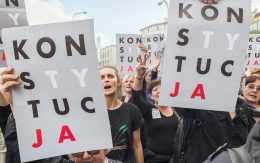
Poland likewise criticised the Court’s decision. On Twitter, Polish justice minister Zbigniew Ziobro argued that the EU can now take away sovereignty and freedom from member states, asserted that the Union is now free to use “unlawful violence”. The Polish government, one of the biggest recipients of EU funds, thus clearly seems threatened by the prospect of EU funds being cut off due to a lack of respect for the rule of law.
The European Commission’s role and the mechanism’s efficacy
Now that the CJEU gave the green light for the mechanism, it is on the European Commission to actually enforce the conditionality. Since the verdict, the European Parliament, in particular, the Renew Europe party, has started pressuring the Commission and the Commission president, Ursula von der Leyen, to finally take action. This is also due to the fact that parliamentary elections are coming up in Hungary in April, and any action that is taken against Hungary before that could affect Orbán’s electoral campaign and possibly impede his reelection.
So far, however, no action has been taken by the European Commission. In a statement, the executive arm of the EU stated that it “will now analyse carefully the reasoning of the judgments and their possible impact on the further steps we will take under the Regulation.”
Yet, even if action is taken against a member state anytime soon, the mechanism is rather suited to prevent large-scale corruption and cronyism rather than general democratic backsliding. As argued by Politico, the regulation is relatively narrowly drafted, and it “only applies to rule-of-law violations that threaten European taxpayers’ money”, therefore being “better suited for combating financial fraud, such as a government corruptly awarding EU money to loyalists”, as has been happening in Hungary for a while, “than it is for upholding democratic norms like LGTBQ+ rights or media freedom”.
Nevertheless, this new mechanism serves as a good basis to inhibit and prevent further corruption from illiberal EU governments, such as the Fidesz government in Hungary and the PiS government in Poland, and to clamp down on cronyism.
It remains to be seen whether the European Commission will take action soon and how targeted member states will react to it.
Sources Bayer, L. (2022): The EU got its legal OK to cut funds. Now what?, Politico, https://www.politico.eu/article/eu-rule-of-law-funding-european-commission-court-of-justice-poland-hungary/ Common Market Law Review (2021): ‘Editorial comments: Compromising (on) the general conditionality mechanism and the rule of law’, (2021), 58, Common Market Law Review, Issue 2, pp. 267-284, https://kluwerlawonline.com/journalarticle/Common+Market+Law+Review/58.2/COLA2021020 European Commission (2022): Statement by European Commission President Ursula von der Leyen on the judgments of the European Court of Justice on the General Conditionality Regulation, https://ec.europa.eu/commission/presscorner/detail/en/statement_22_1106 Greilinger, G. (2020): EU-Funding – A Key Area of Corruption in Hungary, Quo Vademus, https://quo-vademus.org/eu-funding-a-key-area-of-corruption-in-hungary/ Greilinger, G. (2021): Censoring Sexual Identity – Hungary bans LGBT+ Content for Minors, Quo Vademus, https://quo-vademus.org/zensoring-sexual-identity-hungary-bans-lgbt-content-for-minors/ Greilinger, G. (2022): A Pivotal Year For Hungary – Can Orbán finally be defeated in the upcoming 2022 elections?, Quo Vademus, https://quo-vademus.org/a-pivotal-year-for-hungary-can-orban-be-defeated-in-the-2022-elections/ Gremminger, V. (2021): The New Rule of Law Conditionality Mechanism clears its first hurdle –Analysis of AG Campos Sánchez-Bordona Opinions in Hungary v Parliament and Council (C-156/21) and Poland v Parliament and Council (C-157/21), European Law Blog, https://europeanlawblog.eu/2021/12/14/8043/#:~:text=This%20mechanism%20enables%20the%20European,to%206%20of%20the%20Regulation) Reuters (2020): Hungary’s Orban likens EU to former Soviet Union if rule of law criteria accepted, Reuters, https://www.reuters.com/article/us-eu-budget-hungary-idUSKBN27T0ZT Rhawi, C. (2022): EUROPEAN COMMISSION “OUT OF EXCUSES” ON RULE OF LAW CONDITIONALITY REGULATION AFTER ECJ RULING, Renew Europe, reneweuropegroup.eu/news/2022-02-16/european-commission-out-of-excuses-on-rule-of-law-conditionality-regulation-after-ecj-ruling Stevis-Gridneff, M., Pronczuk, M.,Top European Court Rules E.U. Can Freeze Aid to Poland and Hungary, The New York Times, https://www.nytimes.com/2022/02/16/world/europe/eu-court-funds-hungary-poland.html Varga, J. (2022): Twitter Status, Twitter, https://twitter.com/JuditVarga_EU/status/1493880412480974852 Zbigniew, Z. (2022): Twitter Status, Twitter, https://twitter.com/ZiobroPL/status/1493899716643500039





Be First to Comment