
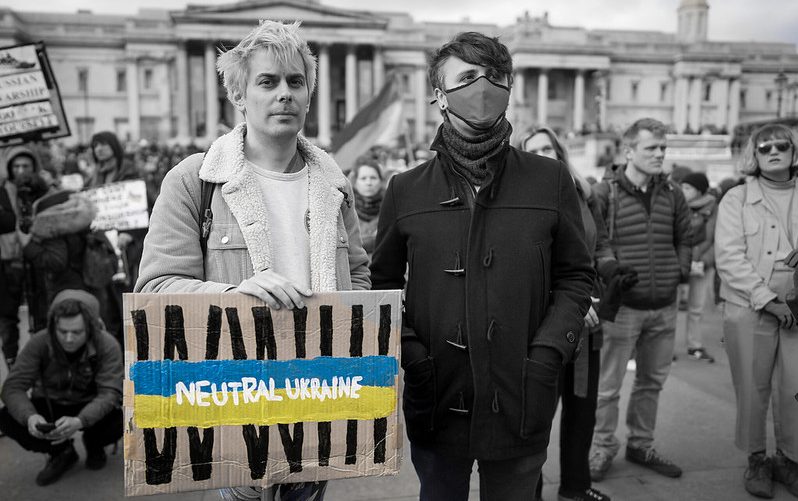
After weeks of Russia amassing troops on its eastern border with Ukraine, the United States’ warning of an imminent attack on Ukraine, and Putin continuously denying any such plans, it turns out that the warnings were justified. The western world watched in awe as Putin first recognised the independence of two eastern Ukrainian regions, Donetsk and Luhansk, where Russian-backed separatists had been fighting Ukrainian forces for years, and when he then launched a full-scale invasion of Ukraine territory in the early morning hours of February 24.
As the world was closely following what was happening in Ukraine, people began contemplating the motivations for Russia’s attack. In particular, discussions about Putin’s acclaimed reasons for the invasion and the Russian propaganda ensued.
According to Putin, the aim is to “demilitarise” and “de-nazify” Ukraine, a claim which is not only outrageous but also incredibly unfounded given that the country’s president, Volodymyr Zelenskyy, is Jewish himself.
In addition, Putin, over the years, repeatedly claimed that NATO is a threat to Russian security – even though neither were any NATO troops ever stationed in Ukraine nor was the alliance openly threatening Russia. Also, NATO did not plan on admitting Ukraine any time soon.
The claim that Putin feels threatened by NATO was not only argued by political scientist Mearsheimer in 2014 – falsely justifying Russian aggression towards its neighbour – it has also been picked up and replicated by Russian propaganda. As stated in this article in The Hill: “Putin wants you to believe it’s because NATO expansion to Ukraine threatens the Russian people and Russia’s security. He doesn’t genuinely believe this. It’s propaganda.”
All in all, Putin’s claims are not only absurd and lack evidence, but they also provide a breeding ground for propaganda and serve as wild justification for this attack and the violation of international law.
Yet, Mearsheimer continues to claim in a 2022 interview with the New Yorker that Putin’s main reason for invading Ukraine is that he feels threatened by NATO and that the war in Ukraine is the West’s fault. In his opinion, a neutral, independent Ukraine would appease Putin. However, this argument is ill-conceived – for two main reasons.
First, as I have also laid down in a previous article, the argument that Russia’s attack on Ukraine is the West’s fault is wrong because the West and, in particular, NATO never threatened Russia as a state. If anything, it is the West’s fault because we have never sanctioned Putin hard enough for his behaviour, especially not after the annexation of Crimea, the poisoning of his political opponents and many other gross violations of our principles. We have not shown him clearly enough what the consequences of his continuous dangerous and erratic behaviour would be.
Aside from that, it is also apparent that, even if Ukraine promises to remain a neutral state and not join any military alliance, Putin will continue his assault on Ukraine: because he denies Ukrainian statehood and its right to existence.
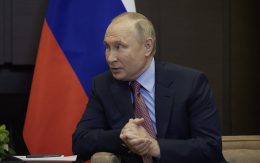
That being said, there is a second argument for why Mearsheimer and others who replicate his opinion are wrong in the assumption that it is NATO threatening Russia. Rather, it is the prospect of liberal democracy, the rule of law and Ukraine’s orientation towards the West and Western ideals that is threatening Putin. This line of argumentation has also been presented by various scholars and experts on the region, such as Anne Applebaum, who argues that Putin wants democracy to fail around the world but in particular in Russia’s immediate neighbourhood.
Democracy is a threat to Putin and his power because ordinary Russians may realise that their leader is not acting in their best interest. And, it is a threat because Russians may aspire and start fighting for democracy too – which would pose an imminent threat to Putin’s power and presidency as well as to his cronies’ wealth and influence.
For the same reason, Putin has oppressed, and poisoned political opponents in the past, supported authoritarian governments in his neighbourhood and beyond in suppressing pro-democracy demonstrations, rolled troops into countries in his “sphere of influence” to clamp down on peaceful protests, and supported right-wing parties all across Europe. Putin fears democracy and how democracy and liberalism in his close neighbourhood could harm his power in Russia – because Russians might strive for the same.
It is naive to think that taking NATO membership off the table for Ukraine would make Putin stop this war. It will not. Putin will continue to topple democracies and violate neighbouring countries’ sovereignty. He does not tolerate flourishing democracies in his neighbourhood and in what he sees as Russia’s historic “sphere of influence”. And his invasion of Ukraine is just another tragic example of that.
Sources AlJazeera (2022): Russian-backed separatists evacuate residents from east Ukraine, https://www.aljazeera.com/news/2022/2/18/russian-backed-separatists-announce-evacuation-from-east-ukraine Applebaum, A. (2022): The Reason Putin Would Risk War, The Atlantic, https://www.theatlantic.com/ideas/archive/2022/02/putin-ukraine-democracy/621465/ Chotiner, I. (2022): Why John Mearsheimer Blames the U.S. for the Crisis in Ukraine, The New Yorker, https://www.newyorker.com/news/q-and-a/why-john-mearsheimer-blames-the-us-for-the-crisis-in-ukraine Person, R. & McFaul, M. (2022): What Putin Fears Most, Journal of Democracy, https://www.journalofdemocracy.org/what-putin-fears-most/ Tafuri, D. (2022): Putin doesn’t fear NATO or Ukraine — he fears democracy, The Hill, https://thehill.com/opinion/international/593627-putin-doesnt-fear-nato-or-ukraine-he-fears-democracy

Be First to Comment