
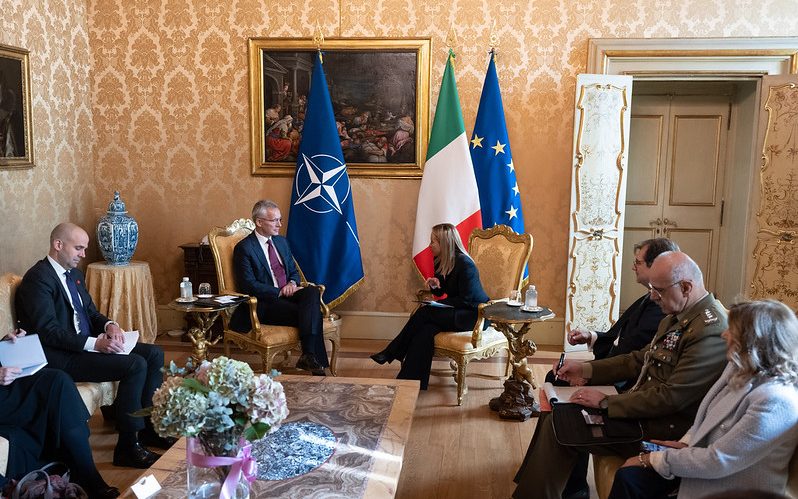
The Italian general elections of 2022 revealed one of the most shocking results over decades of elections held across European countries. Described as ‘the rightest Prime Minister since Mussolini’, Giorgia Meloni of the far-right party Brothers of Italy has now been elected Prime Minister of the country, being the first woman to hold the position.
But for people following the politics of Europe, her accession is not surprising, but rather disappointing given the events transpiring on the continent, and the events that did transpire in its past. Less than 100 years ago, Europe had fallen victim to right-wing sentiments soon after the First World War. In countries like Germany, Italy, and Spain, fascist leaders rose to power during the interwar period. The two most notorious being Adolf Hitler (Germany) and Benito Mussolini (Italy). Their nefarious ambitions ultimately culminated in another World War resulting in over 85 million deaths.
The two colossal wars in less than half a century engendered the concept of a unified Europe under one supranational institution – the European Union. Over the years, the EU has proven to be successful in eliminating tensions between European states and encouraging economic growth and social development. Hence why it is puzzling when history seems to be repeating itself after adopting such measures to avoid conflict and populism. Yet, in all its irony, the EU is the primary reason for the resurgence of the far-right in Europe.
Currently, several European states are gradually shifting towards the right, with right-wing parties garnering more popularity. In the UK, the UKIP conservative party that promoted Brexit proved to be a success; in France, it is Marine Le Pen’s hardcore right-wing party National Rally; in Germany, the populist party Alternative for Germany is gaining more votes in elections; in Spain, the infamous Vox party is also winning more seats in regional and national parliaments; in Greece, a lawyer for the far-right party Golden Dawn was arrested for pulling a Nazi Salute in the Courtroom; in Hungary, Poland, and Italy, populism is evident and conspicuous; and in Nordic countries, right-wing political rhetoric is on the rise.
The multitude of incidents which occurred over the years accumulated into the state of Europe we witness today, and most of these circumstances are a result of EU policies. The most impairing was the Eurozone Debt Crisis which led to a long-term fiscal deficit due to austerity measures imposed by the EU against Ireland, Greece, Italy, Spain, and Portugal. This translated into pension cuts, social welfare cuts, and high unemployment in the countries concerned and, consequently, spiralling unpopularity of the EU. Terrorist attacks which aligned with the period of the refugee crisis in 2016 also allowed conservatives to advocate for closed borders and proliferate xenophobic sentiments and acquire support. The belief that the EU is an elitist, bureaucratic institution was soon well-favoured amongst citizens of the EU. The ordinary people possess no influence over the decision-making processes transpiring in the EU (although that is partially false as elections for European Parliament are held every 5 years). Essentially, the center-liberal parties and leaders who were in power for decades have failed their citizens, and so has the liberal institution of the EU.

What does this mean for Europe? The EU will ultimately dissolve as the major players, Germany and France, elect anti-EU parties. The conceptualization of Italexit and Grexit are also amassing traction. The dissolution of the EU will further divide European states, potentially generating friction. While a hot war is unlikely to erupt given the limited military capabilities of European countries as well as the heavy integration of economy and borders, Europe will not remain the same.
Europe’s international relations will also be reconstructed. The Euro currency might cease to exist as more countries withdraw, engendering political and economic turmoil disrupting trade with countries around the world, and ultimately damaging the global political economy. Non-EU countries will also have to engage deeper with European states, in contrast to existing relations where they prefer to work with the EU. The failure of the EU will also be a glaring indication of the failure and fallout of the liberal world order formed post-Cold War, and the emergence of a new era in the international system.
Sources Britannica (2022) The euro-zone debt crisis [online] available from <https://www.britannica.com/topic/European-Union/The-euro-zone-debt-crisis> Stamatoukou, E. (2022) ‘Greece to Probe Golden Dawn lawyer’s Courtroom Nazi Salute’ Balkan Insight [online] available from <https://balkaninsight.com/2022/10/14/prosecutor-orders-investigation-into-golden-dawn-defense-attorneys-nazi-salute/> The National WWII Museum (2022) Research Starters: Worldwide Deaths in World War II [online] available from <https://www.nationalww2museum.org/students-teachers/student-resources/research-starters/research-starters-worldwide-deaths-world-war>


Be First to Comment