
In the past few years, Europe has witnessed an upsurge of populist trends through several far-right and far-left parties sweeping around the continent. Sometimes with milder, sometimes with harsher manifestos, countries like Hungary, Greece, France, and Italy have been frequently in the spotlight.
Currently, attention has been drawn to Italy and Sweden due to the September elections. The conservative and right-wing party, Brothers of Italy, led by Giorgia Meloni, is part of a larger coalition made up of four right-wing parties that have proposed a unitary program, as many probably know. They are currently campaigning against the Democratic Party, which, in turn, is leading a center-left coalition.
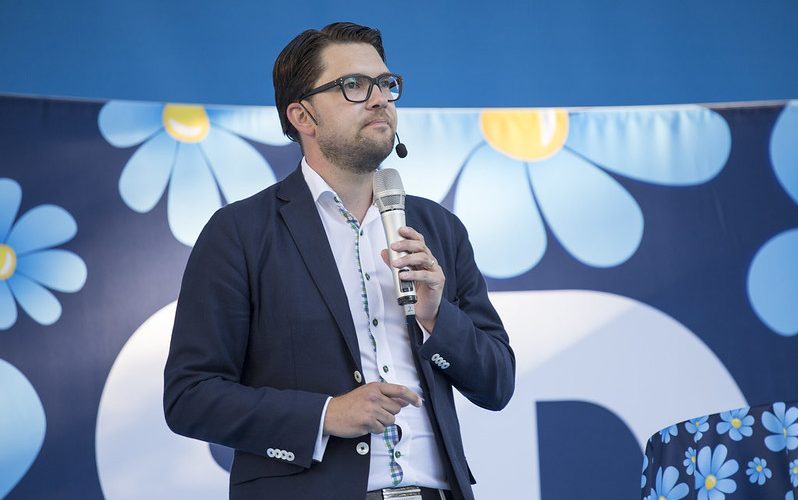
But when it comes to the far right and populism, Sweden is no less engaged. With the upcoming September 11 elections, Sweden’s cities and media are covered in myriad leaflets, each promoting their ambitious programs. One party that needs attention is the Swedish Democrats (Sverigedemokraterna, SD). The Swedish Democrats, founded in 1988 in Stockholm, are a nationalist, socially conservative, and a right-wing populist political party led since 2005 by Jimmie Åkesson. Since its establishment, the party has gradually grown to attract more and more voters throughout the years. For example, in the 2002 parliamentary election, the party received 1.44 percent; in 2006, the percentage increased to 2.93 percent, which was insufficient to secure its presence in parliament. Nevertheless, in the 2010 parliamentary election, the Swedish Democrats obtained 5.7 percent and a ticket to the Swedish parliament. The percentage increased in the parliamentary elections of 2014 and 2018 to 12.86 and 17.53 percent respectively, making it the third largest party in Sweden after the Social Democrats and the Moderates.
This ever-growing percentage is thought-provoking. These numbers reflect nothing but people’s desire for change. If we take a look at the main points of the party programs, we can understand where the disappointment of a large share of the Swedish population mainly lies. As the party highlights on its website under the section “What we want”, some relevant points are made concerning the important changes Swedish society has gone through in the past decades, producing more uncertainty, instability, and poverty. Accordingly, they state that
The Sweden Democrats are not like other parties. It is the other parties that have made Sweden look like it does today. We want to counteract the destructive development that has led to people today being forced to move because they cannot afford to pay the electricity bill. We want to crush the gangs that terrorize our country today and create a welfare state where people do not die in the care queues or due to a lack of care.
Anyone who loves Sweden and wants to break the society-shattering development also thinks like us. The Sweden Democrats will never be satisfied with just making Sweden better – Sweden must be good again (Sverigedemokraterna, 2022).
Therefore, the other parties are to blame for the worsened conditions of Swedish citizens and for the increased fear coming from the gangs operating throughout the country, with a special focus on Stockholm, Goteborg, and Malmö, where immigrants’ life is limited to real ghettos. This, in turn, draws attention to the immigration problem and the previous unregulated immigration policies promoted by the country. Concerning the last point, the party adopts a rather extreme stance as it wants to reduce immigration, especially from those countries defined as “culturally distant” (e.g., Middle Eastern and African ones, which represent the main immigration sources in Sweden) and introduce temporary work permits for labor immigrants with skills that are impossible to find in Sweden. If for many, these points sound too harsh, it must be said, though, that they contain some degree of truth.
Accordingly, in 2015, the number of asylum seekers in Sweden, a destination chosen especially by Afghans and Syrians, reached new heights with a staggering number of 162,877. This prompted the Swedish government to take harsher measures to control immigration flows, including the implementation of a more stringent asylum-seeking procedure under the so-called reunification law. This inverted the country’s old age tendency of extremely friendly behavior towards immigrants, a tendency that goes as far back as the Middle Ages.
The truth is that the country, as with many other European ones, cannot objectively receive and deal with an increased number of immigrants without setting up good plans and reliable infrastructure (if they want to offer truly good living standards). This generated many concerns among the Swedish population, which were promptly taken in and elaborated on by the Swedish Democrats. They mainly leverage the fact that a great amount of social money is given to people who are mostly engaged in criminal activities through gangs made up of non-integrated immigrants. Moreover, the party insists on linking immigration to integration. The mandatory requirements concerning immigration introduced in Sweden are very few, and, most importantly, economic assistance and residence permits are not tied to the immigrants’ integration performance (Skodo, 2018).

As this is a phenomenon easily observable in the country, the party is now requiring more action to restore what is considered a major breach of the native Swedish population’s rights. Accordingly, they demand the protection of the Swedish national heritage and consequently, they are fiercely opposed to the promotion of a multicultural society. Therefore, a major point is the total assimilation of immigrants into Swedish society and not their integration as promoted instead by other parties. This, of course, entails the abolishment of mother tongue teaching in schools, currently a widespread practice, as well as the abolition of religious schools, hijab, and several other religious symbols that do not match the Swedish tradition. Furthermore, the party demands the abolition of all immigrant associations.
Furthermore, with the approaching elections, another issue has come to the spotlight: the alleged party’s proximity to Russia. This is an issue that has concerned all populist parties in Europe, who are viewed as potential trojan horses or useful idiots used by the Kremlin to undermine the unity of the European Union. In February of this year, Jimmie Åkesson, the SD’s leader, was asked whether he preferred Vladimir Putin or Joe Biden. This was not the first time for him. In 2018, he was asked again on Sweden’s radio whether he was more for Putin than for the French president, Emmanuel Macron. In both cases, he refused to answer, even though his party condemned the Russian annexation of Crimea and supported sanctions against Moscow. Moreover, the party asked in 2018 for stricter sanctions after the illegal annexation, defining Russia as a security threat. Nevertheless, this contradicts the leader’s refusal to take a position on the questions posed (Vergara, 2022).
This conundrum seems generated by the fact that, while on the one hand, the SD’s ideology is based on several historical events and myths (e.g., the Poltava battle) that turned Russia into the number one enemy of the Swedish nation, on the other hand, the party bases its manifesto on the battle against another enemy, globalization, something that could potentially bring it closer to Russia. The preservation of Swedish culture is, as pointed out earlier, one of the basic points promoted by the party that fiercely opposes the exaggerated stances on globalism, supranational institutions like the EU, and extreme political correctness.
It is not a secret, though, that some party exponents have been quite Putin-friendly. This was the case in 2017 with the SD Chairman of the city of Nacka, a small city close to Stockholm, David Bergqvist. The local SD politician did not hide his enthusiasm for the Russian leader by stating openly the following: “Putin, I know you are a very good person. I appeal to you: come here and depose our traitor, the state minister and restore order in your poor western brother country” (Poohl et al., 2017).
A party’s black sheep or the voice of truth? It is difficult to say with certainty. Some facts, though, can lead one to assume the latter option. Besides the already cited lack of a proper answer from the SD’s leader over his preferences (Biden, Macron, or Putin), the party has opposed a recent parliamentary decision on more financial support for Ukraine. Moreover, the party was blasted by one of the major Swedish newspapers, the Aftonbladet, for having stated on its webpage that “balance between the major powers must be respected” (Sima, 2022). The statement was later removed, and it is still controversial, regardless of whether it was a powerful party statement vis-à-vis Russia or just bad wording. Whatever it may be, it seems clear that the party’s stance is ambiguous and very often resembles that of leaders like Marine Le Pen and Viktor Orban.
Undoubtedly, the upcoming September election will be a powerful litmus test for Sweden and its voters, hopefully shedding some light on these ambiguities.
Sources Sverigedemokraterna website. Available at https://sd.se/vad-vi-vill/ Skodo, Admir (2018) Sweden: By Turns Welcoming and Restrictive in its Immigration Policy. MPI, Migration Policy Institute. https://www.migrationpolicy.org/article/sweden-turns-welcoming-and-restrictive-its-immigration-policy Vergara, Daniel (2022) Nationalismen tvingar in SD i det ryska hörnet (Nationalism forces SD into the Russian corner). EXPO. https://expo.se/2022/02/nationalismen-tvingar-sd-i-det-ryska-h%C3%B6rnet Poohl, Daniel, Leman Jonathan, and Vergara Daniel (2017) Lokal SD-topp vädjar: “Putin, kom hit och avsätt vår landsförrädare till statsminister” (Local SD top appeals: “Putin, come here and depose our traitor as prime minister”). EXPO. https://expo.se/2017/03/lokal-sd-topp-v%C3%A4djar-putin-kom-hit-och-avs%C3%A4tt-v%C3%A5r-landsf%C3%B6rr%C3%A4dare-till-statsminister Sima, Jonna (2022) Sverigedemokraterna är Putins bästa drängar. Jimmie Åkesson spelar dum och ovetande (The Sweden Democrats are Putin’s best henchmen. Jimmie Åkesson plays stupid and ignorant). Aftonbladet. https://www.aftonbladet.se/ledare/a/5GQBE1/sverigedemokratern-ar-putins-basta-drangar






Be First to Comment